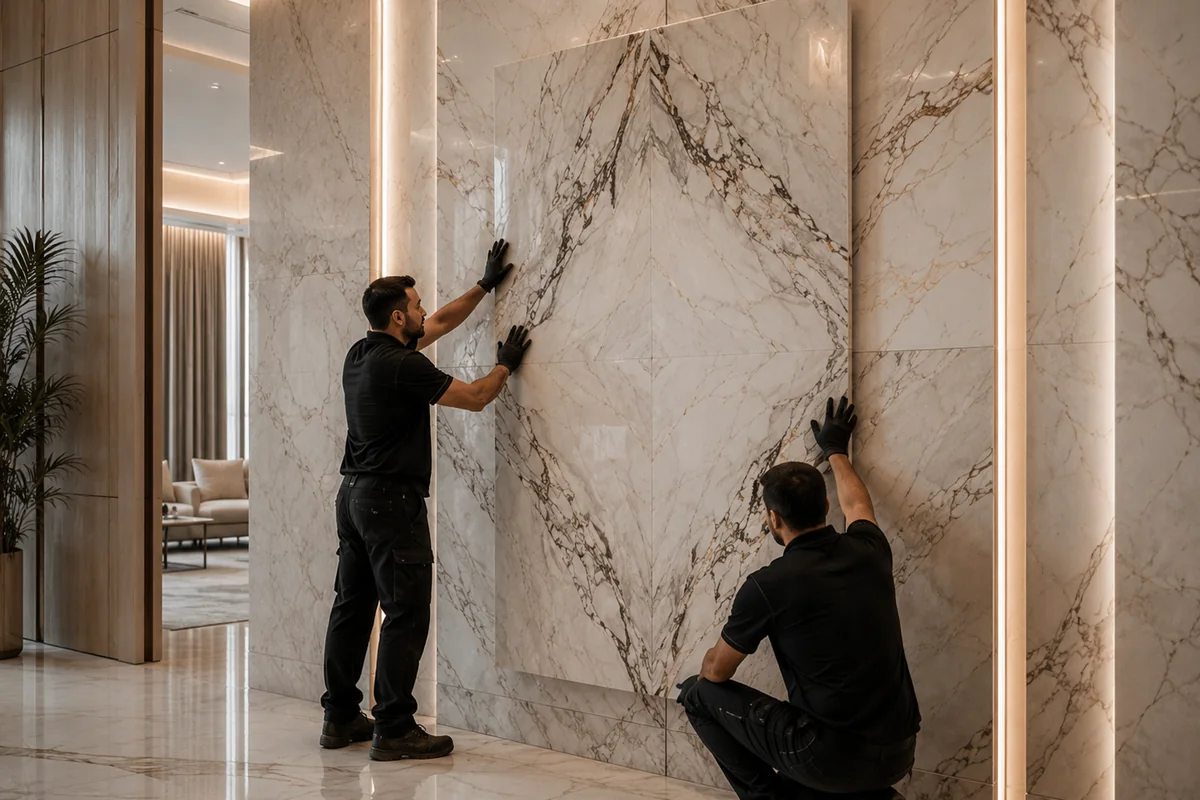
CURRENT UAE MARBLE FIXING PLANNING RATES
Current Marble Fixing & Installation Rates in Dubai
These are UAE Marble Fixing's current starting/planning rates. They separate common applications because a single generic marble rate hides the labour and system differences that actually change the project cost.
| Service / Application | Starting Rate | Unit | What It Represents | What Commonly Changes It |
|---|---|---|---|---|
| Standard Marble Fixing Labour | AED 39 | /m² | Entry planning rate for straightforward fixing labour where the application, substrate and fixing route are already suitable. | Stone type, piece size, substrate preparation, layout, access, cutting, protection and whether the scope is truly labour-only. |
| Villa / Large Area Fixing | AED 41 | /m² | Planning rate for repeated or larger-area installation where work can be sequenced efficiently. | Room breaks, patterns, thresholds, stair interfaces, piece size, logistics, occupied areas and total released quantity. |
| Apartment Marble Installation | AED 45 | /m² | Planning rate for apartment installation where access and room-by-room working often reduce open-area productivity. | Lift booking, loading route, protection, working hours, furniture, demolition, unit size and number of small areas. |
| Marble Floor Installation | AED 69 | /m² | Floor-installation planning rate covering the installation application rather than just a generic fixer day-rate. | Screed condition, levels, lippage control, pattern, drains, thresholds, skirting, removal, access and slab/tile format. |
| Marble Wall Cladding | AED 96 | /m² | Standard interior wall-cladding planning rate for suitable wall applications. | Panel dimensions, wall plumbness, backing, corners, returns, cut-outs, vein direction, height and whether restraint is required. |
| Book-Matched Feature Wall | AED 102 | /m² | Planning rate for wall installation where slab sequence, vein continuity and visual alignment increase coordination. | Slab selection, dry layout, piece numbering, mitres, outlets, corners, site dimensions, height and fixing system. |
| Bathroom Floor & Wall | AED 129 | /m² | Planning rate for combined wet-area floor/wall work where small areas, drains, corners and interfaces add labour. | Waterproofing responsibility, falls, niches, sanitary interfaces, cut-outs, small-piece work, substrate condition and sealing scope. |
| Basic Stair Installation | AED 90 | /step | Installation-only planning rate for a simpler stair component scope where the fabricated stone is already suitable. | Tread/riser scope, nosing, returns, landing pieces, side skirting, geometry, cutting, edge finish and existing stair condition. |
| Complete Marble Staircase — Tread, Riser & Nosing | AED 315 | /step | Planning rate for a fuller stair scope involving coordinated tread, riser and nosing components. | Template accuracy, mitres, returns, edge profile, landing geometry, side skirting, fabrication, protection and piece numbering. |
| Marble Skirting | AED 54 | /lm | Planning rate for skirting installation measured by linear metre. | Height, thickness, mitred corners, exposed edges, wall condition, door returns, piece lengths and cutting. |
| Existing Floor Removal | AED 18 | /m² | Planning rate for removal of an existing finish before new installation. | Existing material, bed thickness, access, debris route, disposal, protection, noise restrictions and hidden substrate damage. |
| Outdoor Marble / Stone Installation | AED 54 | /m² | Planning rate for suitable exterior horizontal stonework where exposure and drainage must be considered. | Substrate, falls, drainage, stone thickness, heat/exposure, joints, access, edging and movement requirements. |
| Poolside Stone Installation | AED 66 | /m² | Planning rate for pool-adjacent stone installation where wet exposure, falls and edge details matter. | Drainage, slip-finish requirements, coping/edge pieces, waterproofing interface, curves, level changes and access. |
| Exterior Wall Stone Cladding | AED 114 | /m² | Planning rate for exterior vertical stone where weather exposure changes the technical scope. | Panel size/weight, substrate, height, access, restraint, joints, cavity/drainage detail, engineering and approved system. |
| Feature Column Cladding | AED 126 | /m² | Planning rate for column cladding where corners, returns, radial/rectangular geometry and repeated alignment add detail. | Column shape, mitres, radius, backing, vertical height, piece size, edge finish, cutting and fixing route. |
| Mechanical Fixing / Installation | AED 126 | /m² | Planning rate for mechanically restrained stone installation rather than a straightforward bonded wall. | Anchor/bracket system, substrate, panel weight, cavity, drilling, shop drawings, access, engineering and approvals. |
| Large-Format Dry Fixing | AED 144 | /m² | Planning rate for large-format dry/mechanically restrained panels with greater handling and restraint requirements. | Panel dimensions/weight, lifting, rail/bracket system, tolerances, joints, substrate, height and approved fixing design. |
| Complex Anchor / Rail Fixing | AED 162 | /m² | Planning rate for more involved anchor/rail layouts where fabrication and fixing interfaces need tighter coordination. | Proprietary components, anchor locations, substrate testing, shop drawings, panel preparation, access and engineering requirements. |
Rates shown are planning references from UAE Marble Fixing's current website pricing structure. They are not presented as Dubai-wide market averages.
WHY ONE NUMBER FAILS
Why Marble Fixing Does Not Have One Price Per Square Metre
Two projects can have the same measured area and still require very different labour because area describes quantity, not difficulty, fixing system or number of interfaces.
A 100 m² open villa floor can be sequenced in long runs with repeated levels and relatively few corners. The same 100 m² split across bathrooms can include drains, niches, sanitary interfaces, waterproofing coordination, small wall areas and many cut pieces. Both may be written as 100 m², but the labour pattern is completely different.
The same problem appears on walls. Thirty square metres of standard interior cladding on a prepared low wall is not equivalent to thirty square metres of heavy large-format panels at height with mechanical restraint. The second scope may add anchors, rails, drilling, panel preparation, shop-drawing coordination and access equipment.
Area alone does not describe the labour
The rate becomes meaningful only when the application and detail density are known.
Open repetitive areas usually allow better crew flow than small rooms, columns, thresholds, stair returns or heavily cut walls. When a quotation looks unusually low, check whether it assumes open-area productivity that your project does not actually have.
The fixing system can change the entire cost structure
A bonded floor and a mechanically restrained wall are different construction scopes.
Mechanical fixing introduces a load path through anchors, brackets, rails or another approved system. That changes materials, preparation, drilling, setting-out, tolerances and often documentation.
Small quantities can cost more per unit
Mobilisation, measurement, protection and setup still happen even when the measured area is small.
A six-square-metre feature wall can contain more cutting, outlets, mitres and visual alignment per square metre than a much larger plain floor. A minimum practical crew setup can therefore make the unit rate look higher on small detailed scopes.
FLOOR COST
Marble Floor Installation Cost
Floor pricing depends on how much of the job is clean, repeatable laying and how much is preparation, set-out, cutting, level control and interface work.
UAE Marble Fixing's current marble floor installation planning rate starts from AED 69/m², while standard fixing labour starts from AED 39/m². Those figures represent different scope assumptions. The floor-installation route is the more useful reference when the contractor is responsible for the floor application rather than only supplying generic labour.
Before using any floor rate, confirm whether the substrate is already level and sound, whether existing finishes must be removed, and whether thresholds, skirting, drains, patterns or occupied-property protection are included.
Flooring & Wall Cladding
Use the service page when you are ready to move from cost research to an actual floor/wall installation scope.
View installation service →Standard marble floor installation
Use the AED 69/m² starting point when budgeting a normal floor-installation application, then adjust the quote from the actual substrate, stone format and layout.
Large pieces need more coordinated handling and plane control. Small patterned work can increase cutting and set-out. A floor with many thresholds or changes of finish may spend more labour at edges than a plain open floor.
Villa and large continuous areas
Larger repeated areas can improve workflow, but only when enough area is actually released and accessible.
The AED 41/m² villa/large-area planning rate is not a promise that every villa floor falls into one band. Multiple levels, stair connections, double-height access, book-matched areas and late work by other trades can remove the productivity benefit of scale.
Apartment renovation
Apartment installation starts from AED 45/m² in the current planning structure, but high-rise logistics can matter more than room area.
Lift booking, loading-bay windows, protection of common areas, noise restrictions, furniture movement and debris routes can turn a small apartment into a logistics-heavy job.
Existing floor removal and preparation
Existing floor removal starts from AED 18/m² as a planning rate, but demolition does not tell you what is underneath.
After removal, hollow screed, adhesive build-up, cracks, moisture or level differences may need separate preparation before new marble can be installed.
VERTICAL STONE
Marble Wall Cladding Cost
Wall pricing rises as panel size, height, visual alignment and restraint requirements increase. A square metre on a wall carries different handling and safety consequences from the same square metre on a floor.
Current planning rates start from AED 96/m² for standard interior wall cladding, AED 102/m² for book-matched feature walls, AED 114/m² for exterior wall stone cladding and AED 126/m² for mechanical fixing. Those rates are intentionally separated because each scope adds different control points.
For wall work, the quotation should identify panel dimensions, thickness, wall condition, exposed corners/returns, cut-outs, height, access and whether the stone is bonded or mechanically restrained.
Mechanical Fixing / Installation
Use this page when large, heavy or high-level vertical stone may require a mechanically restrained system.
Explore mechanical fixing →Interior wall cladding
The AED 96/m² planning rate is a starting point for suitable interior wall work.
Flatness and plumbness matter because vertical deviations accumulate visually. Cut-outs, wall returns, corner mitres and socket positions can add more labour than the centre of the wall.
Book-matched feature walls
Book-matched installation starts from AED 102/m² because layout is not only about covering area.
Slab sequence, vein direction, centreline, visual joints and piece numbering may need to be agreed before cutting and fixing. A late change to socket or joinery position can disturb the entire composition.
Exterior stone walls
Exterior wall cladding starts from AED 114/m², but exposure can change the fixing system and access assumptions.
Weather, height, movement, drainage/interface details and engineer/consultant requirements can move a project away from a straightforward interior-wall scope.
Large-format and mechanically fixed panels
Mechanical fixing starts from AED 126/m², large-format dry fixing from AED 144/m² and complex anchor/rail fixing from AED 162/m².
These are different scopes because mechanical restraint adds component selection, drilling or slots, panel preparation, anchors/rails/brackets, tolerances and sometimes project-specific engineering or shop drawings.
STAIR COST
Marble Staircase Cost
A staircase should be priced by the actual component package—not by treating each step as a flat tile.
Basic stair installation starts from AED 90 per step in the current planning structure. A complete marble staircase scope covering tread, riser and nosing starts from AED 315 per step. The difference is scope: the second rate represents a coordinated set of fabricated components with more edges, joints and geometry.
Before comparing stair quotations, identify whether the stone is already fabricated, whether nosing/returns are included, how landings are measured, whether side skirting is part of the package and what happens when existing stair dimensions vary from step to step.
Basic stair installation
Use the AED 90/step figure only for a simpler installation scope where the required stone components are already suitable.
If the installer still needs templating, cutting, edge finishing or correction of the stair base, those items should not be hidden inside a basic installation label.
Complete tread, riser and nosing scope
The AED 315/step planning rate reflects a fuller component package.
Tread depth, riser height, nosing, mitres, returns, landings and exposed edges all need to line up. Each step becomes a small assembly rather than one square metre of open floor.
What makes stair work expensive
Geometry and repetition are the key questions.
- Non-uniform existing stair dimensions
- Mitred or profiled nosings
- Landing and return pieces
- Side skirting
- Edge polishing
- Piece numbering
- Restricted access and protection
METHOD CHANGES PRICE
Wet / Adhesive Fixing vs Dry / Mechanical Fixing Cost
The fixing method is not a cosmetic choice. It changes the materials, preparation, labour sequence and responsibility built into the quotation.
Suitable interior floors and some wall applications may be installed with a bonded mortar/adhesive route where the selected stone, substrate and system allow it. Mechanically restrained stone is different: the load is transferred through anchors, brackets, rails or another approved restraint system, so panel preparation and setting-out become part of the technical package.
UAE Marble Fixing's current planning rates show that difference: mechanical fixing starts from AED 126/m², large-format dry fixing from AED 144/m² and complex anchor/rail fixing from AED 162/m². These are not 'premium versions' of the same work; they are different scopes.
Marble Fixing Methods
Read the fixing-method guide to understand bonded, wet, dry and mechanically restrained routes before comparing cost.
Compare fixing methods →When a bonded / wet route may be simpler to price
Where a compatible bonded system is appropriate, pricing can focus on substrate readiness, bed/adhesive, layout, coverage and installation labour.
The suitability still depends on the actual stone, size, substrate, moisture/exposure and selected product/system requirements.
What mechanical fixing adds to the cost
Mechanical restraint adds more than metal hardware.
- Anchor/bracket/rail components
- Panel drilling, slots or approved fixing interfaces
- More precise setting-out and tolerances
- Substrate verification
- Access and lifting
- Shop drawings or engineering where required
- Inspection/approval requirements
Why engineering or consultant requirements can override a cheap method
If the project specification or approved system requires mechanical restraint, choosing a cheaper adhesive-only route is not a like-for-like saving.
The quote must follow the approved project requirement. A pricing guide cannot replace project engineering or manufacturer/system documentation.
STONE CHANGES LABOUR
Material, Size and Thickness: How Stone Changes Labour Cost
The same room can price differently when the stone changes because weight, hardness, fragility and piece dimensions change how the crew handles and fabricates each component.
Marble may contain veins, fissures or mesh-backed areas that need careful handling. Granite and quartzite can increase cutting/tooling effort. Onyx can be fragile and visually unforgiving. Limestone and travertine can have pores or bedding characteristics that affect edge handling. Large-format porcelain or sintered slabs are different manufactured materials with their own handling and installation requirements.
The point is not that one material is always expensive to install. It is that the quotation must reflect the actual product rather than using a generic 'marble' line for every stone-like surface.
Marble Cutting & Stone Fabrication
Use the cutting page when the scope includes cut-to-size pieces, mitres, profiles, holes, cut-outs, stairs or labelled components.
Explore fabrication →Large pieces change handling and breakage risk
As pieces get larger, more of the cost can move into lifting, suction handling, team coordination, route planning and plane control.
One damaged large panel can also have a different replacement consequence from one small floor tile.
Hard or fragile materials change fabrication time
Hard stone can require slower cutting and finishing; fragile or fissured stone may require more conservative handling and edge treatment.
Where cutting is part of the project, clarify whether it is included in the installation rate or quoted under fabrication.
Natural variation can increase layout and selection work
Vein direction, shade, book-matching and defect avoidance can add a layout stage before permanent cutting or fixing.
That coordination is especially important on feature walls and stairs where adjacent pieces are visually read as one composition.
WHAT IS UNDER THE STONE
Substrate Preparation and Hidden Conditions
The installation rate assumes something about the surface receiving the marble. If that assumption is wrong, preparation can become a separate cost before fixing starts.
Drawings can show nominal levels and wall positions, but they cannot prove that a screed is sound, that an existing finish is well bonded, that moisture is absent or that a wall is actually plumb. Site inspection therefore matters most when the existing condition is uncertain or when renovation work exposes old construction.
Typical cost changes include removing old adhesive or mortar, correcting levels, repairing weak or hollow areas, coordinating with waterproofing, and waiting for another trade to complete the surface or interface the stone depends on.
What the installer can price from drawings
Drawings can establish area, locations, nominal dimensions, layout intent and many interfaces.
They are strongest when the project is new, coordinated and the substrate specification is known. They are weaker at predicting hidden renovation conditions.
What normally needs site inspection
Actual flatness, plumbness, access, existing finish condition, visible cracking, moisture signs, demolition route and physical interfaces are site questions.
A site visit still cannot see through concealed construction, so concealed defects may only become apparent after removal or opening-up.
SITE LOGISTICS
Access, Height, Working Hours and Site Logistics
Two identical marble details can cost differently when one is on a ground-floor villa and the other is behind a loading bay, service lift and night-work permit.
Access affects labour because stone must travel from delivery point to installation point without damaging the material, building or completed work. High-rise projects may require booked lifts, protected common areas, restricted delivery windows and longer internal movement routes.
Live hotels, malls, restaurants and occupied homes can add protection, phased working, quiet periods and daily cleanup that do not exist on an open construction floor.
High-rise and restricted-access projects
High-rise logistics can include loading-bay booking, service-lift dimensions, trolley routes, temporary storage and lifting restrictions.
If a panel does not fit the planned route, the installation method and even fabrication size can change.
Occupied homes and live commercial spaces
Protection and sequencing are part of the scope when the customer must keep using adjacent areas.
Furniture movement, dust control, temporary access and end-of-shift cleaning can reduce daily output compared with an empty site.
Night work, permits and programme pressure
Restricted working hours do not create one universal surcharge, but they can change crew productivity, supervision and mobilisation.
The quotation should state the working-hour assumption instead of hiding it inside the unit rate.
COMPARE LIKE WITH LIKE
Labour-Only vs Supply-and-Install Quotes
Many marble quotations look different because they are not pricing the same commercial boundary. One may be installation labour only; another may include material, fabrication, transport, adhesives, protection or access equipment.
| Scope Item | Labour-Only Quote | Supply & Install Quote | What to Confirm |
|---|---|---|---|
| Stone / slab supply | Usually excluded | May be included | Material name, grade/batch, thickness, quantity, wastage and approval basis |
| Cutting / fabrication | Often separate | May be included | Cut-to-size, mitres, profiles, holes, sink/hob cut-outs, stair pieces |
| Delivery | May be separate | May be included | Delivery point, offloading and timing |
| Lifting / handling | Basic handling may be assumed | Project-dependent | Large panels, cranes/hoists, service lifts, long carry distance |
| Adhesive / mortar | Confirm | May be included | Exact system, primer, bedding materials and exclusions |
| Anchors / brackets / rails | Normally not in a basic labour rate | Project-dependent | Proprietary system, fabrication, drilling, quantity, engineering/approval |
| Substrate preparation | Minor prep may be assumed | Project-dependent | Level correction, screed repair, plaster/render correction, moisture issue |
| Installation labour | Included | Included | Application, measured quantity and fixing route |
| Grout / joint treatment | Confirm | Confirm | Joint material, sealant, movement-joint responsibility |
| Sealing / protection | Often separate | May be included | Sealer type, coats, temporary floor protection, handover protection |
| Removal / disposal | Separate unless stated | Project-dependent | Existing finish, debris route, disposal responsibility |
| Access equipment | Separate unless stated | Project-dependent | Scaffold, tower, cradle, hoist, permits |
| VAT | Follow quotation | Follow quotation | Do not assume inclusion; check the written commercial document |
Neither column is a legal universal rule. The written quotation controls what is actually included.
QUOTE BOUNDARIES
What Is Usually Included and What Can Be Extra?
Use this as a quotation-checking list, not as a promise that every project contains the same inclusions.
Items often associated with the agreed installation scope
Depending on the written quotation, core labour may cover standard setting out, alignment, ordinary installation workmanship and standard joint work for the agreed application.
- Installation labour
- Standard setting out
- Normal alignment / level control
- Standard joint work
- Ordinary tools for the agreed scope
Items that often need separate confirmation
These are common reasons two quotations with the same headline area are not directly comparable.
- Stone/material supply
- Special fabrication and edge profiles
- Waterjet/inlays
- Mechanical anchors or proprietary systems
- Scaffolding or special lifting
- Major substrate repair
- Removal/disposal
- Occupied-property protection
- Restricted/night working
- Transport/logistics
- Specialist sealing
- Mock-ups / shop drawings
COMPARE QUOTATIONS
How to Compare Marble Fixing Quotations
Put the quotations side by side and make the scope columns match before you decide which number is lower.
- Is the measured quantity the same?
- Is the application the same: floor, wall, stair, exterior or mechanical?
- Are the material, thickness and piece dimensions the same?
- Is the fixing method clearly identified?
- Is substrate preparation included to the same level?
- Are cutting, cut-outs, mitres and edge work treated the same?
- Do both quotes include the same access, lifting and scaffolding assumptions?
- Is demolition/removal included or excluded in both?
- Is material supply included in one but not the other?
- Are protection, cleaning and handover responsibilities comparable?
- Is VAT treatment stated the same way?
- Do programme, working hours and warranty/handover terms match?
Why the cheapest line rate can become the most expensive final quote
A low rate wins only when it buys the same scope.
If the cheapest line excludes removal, preparation, cut-outs, access or the required fixing system, the final total can rise through variations. A higher-looking but complete line can be easier to control because the commercial boundary is clear before work starts.
FROM BUDGET TO QUOTE
How to Get an Accurate Marble Fixing Quote
The fastest way to improve quotation accuracy is to send information that removes assumptions before the rate is applied.
- Exact project location and property/project type
- New build or renovation
- Floor, wall, staircase, exterior or other application
- Stone/material name and thickness if known
- Typical piece dimensions or slab/tile format
- Drawings, BOQ, cutting list or marked-up photos
- Measured area, linear metres or step count
- Clear site and substrate photographs
- Floor level, loading/access information and working hours
- Target programme / required date
- Whether material is already purchased
- Whether cutting/fabrication is required
- Whether existing stone/tile must be removed
Request a Project Quote
Send the actual site information instead of asking for a blind one-line rate.
Send project details →- 01
Send drawings / photos
Show the application, interfaces and current site condition.
- 02
Confirm quantity and application
Separate floor, wall, stair, exterior and mechanical scopes instead of one total area.
- 03
Confirm material and fixing route
Stone type, dimensions, thickness and project specification help determine the installation method.
- 04
Inspect the site if required
Use inspection where substrate, access or renovation conditions cannot be confirmed from documents.
- 05
Receive a written scope and quotation
Compare the final inclusions, exclusions, unit rates and project assumptions in writing.
WORKED BUDGET EXAMPLES
What the Starting Rates Look Like When You Apply Them
These are simple arithmetic examples using current website starting rates. They are not final quotations and they do not add material, fabrication, access, preparation or other project-specific items unless stated.
50 m² marble floor installation
50 × AED 69/m² AED 3,450 starting labour calculationFinal cost can increase with removal, screed correction, pattern work, thresholds, skirting, large-format handling or restricted access.
25 m² interior marble wall cladding
25 × AED 96/m² AED 2,400 starting labour calculationCorners, cut-outs, wall correction, book-matching, height or mechanical restraint can change the final wall scope.
12-step complete marble staircase
12 × AED 315/step AED 3,780 starting calculationFinal stair cost depends on fabrication, nosing, returns, landings, side skirting, geometry and whether stone supply is included.
20 m² mechanical fixing
20 × AED 126/m² AED 2,520 starting installation calculationAnchors, rails, brackets, panel drilling, engineering, shop drawings and access may change the mechanically fixed scope.
30 lm marble skirting
30 × AED 54/lm AED 1,620 starting calculationSkirting height, thickness, corners, mitres, door returns and edge finishing affect the final item.
15 m² existing floor removal
15 × AED 18/m² AED 270 starting removal calculationDebris route, disposal, thick beds and hidden substrate defects can change demolition/preparation cost.
Do not combine these examples into one package price. Each example is a separate planning illustration.
BEFORE YOU ACCEPT THE NUMBER
Before You Treat Any Marble Rate as Your Project Price
A rate becomes useful only after you know what sits inside it.
Is the rate labour only?
Check whether stone, adhesive, grout, protection, transport and fabrication are excluded before comparing it with a supply-and-install figure.
Is material included?
If yes, confirm material name, thickness, grade/batch and wastage basis; if no, keep material supply outside the labour comparison.
Is the fixing system confirmed?
A bonded floor and a mechanically restrained wall should not be priced as the same generic fixing item.
Is substrate preparation included?
Level correction, removal, screed repair or wall correction can materially change the final amount.
Are stairs, cut-outs and mitres separate?
These details consume labour that a simple m² rate may not include.
Is access equipment included?
Scaffold, tower, hoist, service-lift constraints and lifting may be separate project logistics.
Are removal and protection included?
Renovation work often needs demolition, debris movement and protection of occupied/finished areas.
Is the quantity final?
The final measured area, linear metres and step count should match the quantity used in the quotation.
PROJECT SCALE CONTEXT
Project Volume Changes the Way Labour Is Planned
These completed-project records show scale and delivery context only. They do not prove a universal rate and we do not assign historic contract values or fixing rates that are not in the project record.
604Villas
Akoya Oxygen
Repeated villa programmes can benefit from standardised details and sequencing, but only where the same scope is genuinely repeated.
View case study → 1,850VillasDAMAC Phase 1
Large repeated programmes make measurement control, fabrication flow and released work fronts commercial factors in their own right.
View case study → 14VillasDubai Hills Private Villas
A smaller villa package can contain more project-specific finishes and interfaces per property than a mass repeated programme.
View case study →The AED figures in this guide are UAE Marble Fixing planning rates. Published Dubai quotations can differ because some include preparation, adhesives, grout, material supply, polishing or wet-area work while others do not. Compare the inclusions, exclusions and measured scope before comparing the final rate.
- UAE Marble Fixing planning rates are the figures used in the tables and examples.
- Public market references were not averaged into a new company rate.
- Material-supply prices are not mixed with labour-only fixing rates.
- Final project pricing follows the written quotation after scope review.