MARBLE RESTORATION IN DUBAI

Marble Restoration in Dubai

Repair the defect. Rebuild the finish around it.

For marble with cracks, chips, deeper scratching, open joints, localized damage or wear that cleaning and routine polishing cannot correct on their own. We separate repair work from surface refinishing, then rebuild the visual finish around the corrected area as far as the stone and defect allow.

Repair Before FinishCracks, chips and open defects are addressed before final polishing is used to blend the repaired area.
Localized Where PracticalWe do not automatically grind an entire floor when the defect can reasonably be isolated.
Expectation Set FirstColour, vein and old repair visibility are discussed before work where an invisible repair cannot be guaranteed.
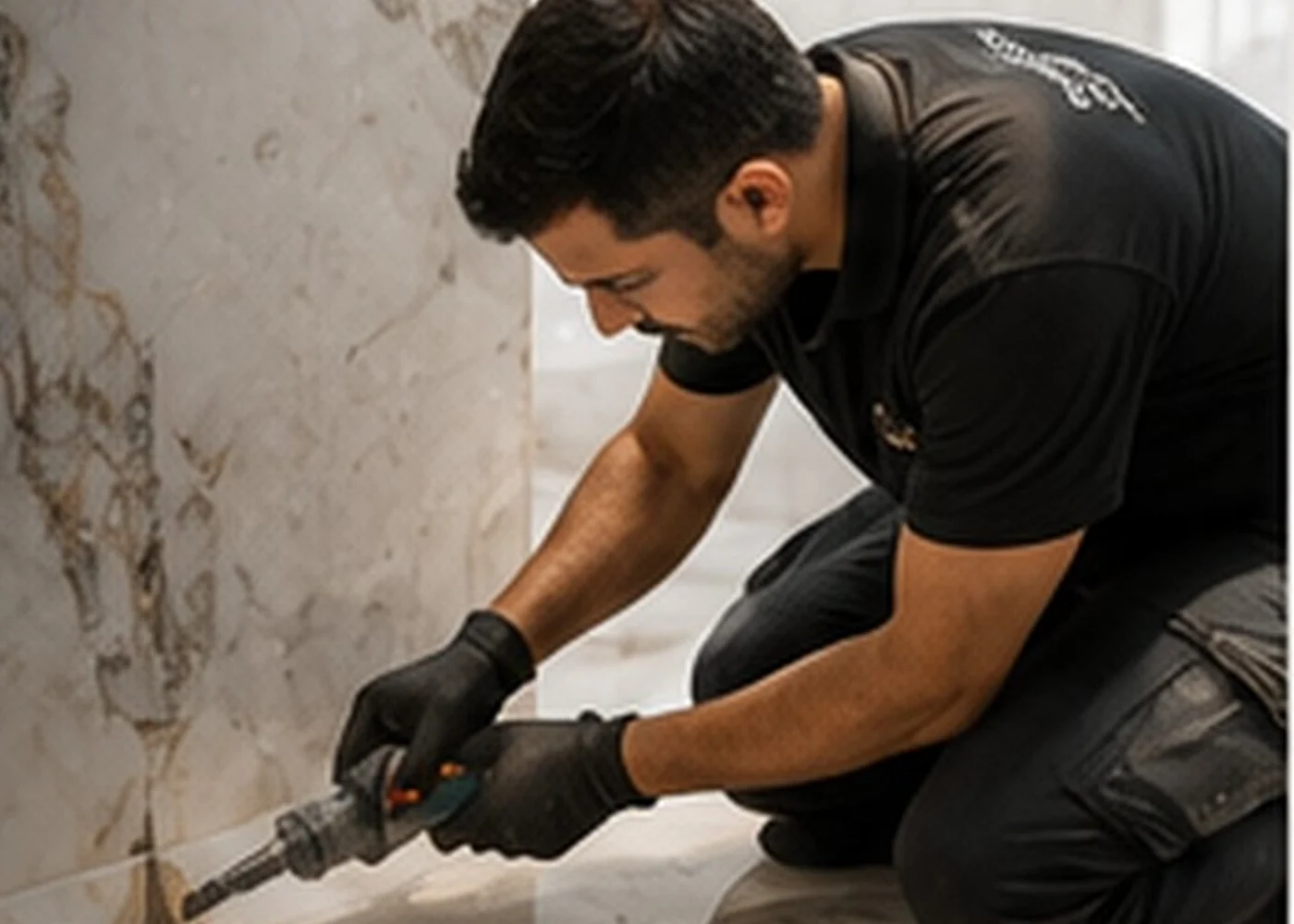
Marble technician repairing a damaged natural stone joint and edge in a Dubai interior

IS RESTORATION THE RIGHT SERVICE?

Choose restoration when the stone needs correction — not just cleaning or shine.

Restoration becomes relevant when the defect sits deeper than routine surface maintenance. The scope can combine repair, grinding or honing, scratch reduction, joint correction and final polishing depending on what the marble actually needs.

RESTORATION IS USUALLY THE RIGHT ROUTE WHEN

  • Cracks, chips, broken corners or damaged edges are visible and need localized repair.
  • Scratches are deep enough to remain obvious after cleaning and light polishing or can be felt with a fingernail.
  • Open joints, minor lippage or isolated damaged areas interrupt an otherwise usable marble installation.
  • Previous repairs, etching or uneven wear require blending before the final finish can look consistent.

A LIGHTER SERVICE MAY BE ENOUGH WHEN

  • The main issue is dirt, grease, detergent residue or stained grout rather than damage to the marble itself.
  • The stone is structurally sound and only needs gloss recovery or light finish correction.
  • A loose or moving slab points to an installation/substrate issue that must be assessed before surface restoration.
  • The defect is caused by ongoing moisture, structural movement or another source that should be corrected first.
CHECK MARBLE POLISHING

WHAT MARBLE RESTORATION CORRECTS

Damage types that need more than a cleaning or maintenance polish.

Restoration is a combination of repair and finish correction. The exact route depends on defect depth, location, stone movement, existing joints and how closely the repaired area can be blended with surrounding marble.

01

Cracks and fractured lines

Hairline or localized cracks can interrupt the finish and collect dirt even where the slab remains generally stable.

Target: clean, fill and finish the repair where the substrate condition permits.
02

Chips and broken edges

Corners, thresholds, stair noses and exposed edges can lose small sections through impact or previous damage.

Target: rebuild the missing edge profile and blend it with the adjacent finish as closely as practical.
03

Deep scratches and gouges

Marks that sit below the normal polish layer require more abrasive correction than routine polishing alone.

Target: reduce the defect through controlled grinding/honing without over-cutting unaffected areas.
04

Open or failed joints

Joints can crack, separate or discolor, leaving visible lines even where the slabs themselves remain usable.

Target: remove failed material where appropriate and renew the joint within the agreed scope.
05

Localized lippage or uneven transition

Adjacent stone edges may sit at visibly different levels from installation, movement or previous replacement work.

Target: assess whether local correction is safe before grinding or blending high edges.
06

Patchy previous repair or finish

Old fillers, mismatched sheen or localized grinding can leave a visibly inconsistent area around earlier work.

Target: improve continuity between repair, surrounding stone and final finish.

WHAT HAPPENS ON SITE

Repair the defect first. Refinish only as far as the correction requires.

A restoration scope is built around the actual failure. Some jobs are isolated crack or chip repairs; others need a wider honing or polishing zone so the repaired area does not stand out against the surrounding marble.

  1. 01

    Inspect the defect and the reason it developed

    We review crack direction, chip depth, joint condition, lippage, hollow movement indicators and previous repairs before deciding whether a cosmetic restoration is appropriate.

  2. 02

    Stabilize the working area and prepare the repair

    Loose material, failed filler or contaminated joint material is removed where required, and the repair area is cleaned so the new repair is not bonded onto unstable debris.

  3. 03

    Fill, rebuild or correct the localized defect

    Compatible repair material is selected for the defect. Chips and edges may require shape reconstruction; cracks and joints require different preparation and cannot be treated as the same repair.

  4. 04

    Level and blend the repair into surrounding stone

    Excess repair material is refined and, where necessary, the adjacent marble is honed through controlled stages so the repaired zone does not remain visibly proud or excessively dull.

  5. 05

    Finish, inspect and set realistic handover expectations

    The repaired area is polished or finished to suit the surrounding surface, then checked for edge continuity, residual movement, colour difference and practical maintenance requirements.

Close view of a marble repair zone being prepared by a technician
Repair visibility depends on stone pattern, defect depth, previous movement and how much surrounding finish must be blended.

MARBLE RESTORATION RATES

Starting prices reflect the level of correction — not one flat restoration fee.

Restoration can range from a single chip repair to wider honing and refinishing. These starting rates help with planning, while the final scope depends on defect depth, area, access and whether movement or substrate issues are present.

Service scopeFromUnitWhat it covers
Full Marble / Stone RestorationAED 27/m²Surface restoration where broader correction and refinishing are required
Scratch Reduction & BlendAED 33/m²Additional controlled refinement for visible scratching beyond routine polishing
Crack FillingAED 48/repairLocalized crack preparation, filling and finish correction for suitable stable defects
Chip RepairAED 54/repairLocalized edge or corner reconstruction and blending
Premium Restoration PackageAED 48/m²Restoration, polishing and compatible sealing where all stages are required

Full Marble / Stone Restoration

AED 27 /m²

Surface restoration where broader correction and refinishing are required

Scratch Reduction & Blend

AED 33 /m²

Additional controlled refinement for visible scratching beyond routine polishing

Crack Filling

AED 48 /repair

Localized crack preparation, filling and finish correction for suitable stable defects

Chip Repair

AED 54 /repair

Localized edge or corner reconstruction and blending

Premium Restoration Package

AED 48 /m²

Restoration, polishing and compatible sealing where all stages are required

Indicative starting rates only. Final pricing depends on stone type, defect depth, quantity of repairs, required grinding/honing stages, access and project conditions. Structural movement, moisture correction, slab replacement and specialist material matching are excluded unless specifically stated.

Refinished natural marble floor in a premium Dubai interior after corrective stone work

THE FINISH AFTER REPAIR

A technically sound repair still needs the surrounding finish to make visual sense.

Restoration is not finished when the crack or chip is filled. The repair and adjacent marble may need controlled honing or polishing so the corrected area sits naturally within the existing surface.

01

Localized repair and polish blend

For small cracks or chips where the surrounding finish only needs a limited blending zone.

02

Honed restoration finish

For areas where a lower-sheen result is more appropriate or where a polished finish is not the existing design intent.

03

Polished restoration finish

For sound marble around the repair where gloss and reflection need to be rebuilt after corrective work.

04

Restoration plus compatible sealing

Where the stone, repair and use area benefit from a protective sealer after the final finish is established.

WHERE MARBLE RESTORATION IS USED

Repair-led work for high-visibility marble areas and localized damage.

Edges, stairs and thresholds behave differently from large open floors. The repair method and blending zone are selected around how the damaged element is constructed and used.

Villa & apartment marble floorsStair treads, risers and nosingsThresholds, doorways and edge detailsLobby and reception floorsBathroom and vanity marbleSelected wall panels and architectural stone edges

MATERIAL SUITABILITY

Repair material and finish route change with the stone.

Veining, porosity, hardness, fill history and existing sealers all affect repair visibility and finishing response. Exact colour and vein replication is not always physically possible, especially in highly figured natural stone.

Natural MarbleCommon restoration material; repair visibility depends strongly on veining, colour and defect location.
TravertineVoids, factory fills and open pores may require fill review as part of restoration.
LimestoneSofter finishes can require conservative repair and refinement to avoid creating a visibly over-polished patch.
TerrazzoRepair approach depends on matrix colour, aggregate size and the ability to match the surrounding composition.
CLEANING, POLISHING OR RESTORATION?

Use restoration when the defect has moved beyond maintenance and finish wear.

The three services solve different layers of the problem. Restoration is the corrective route when repair or deeper abrasion is genuinely required.

DIRT / BUILD-UP

Marble Cleaning

Choose cleaning when residue, grease, soil or dirty joints are the main issue and the stone itself is not damaged.Cleaning cannot fill cracks, rebuild chips or mechanically remove deep scratching.View cleaning →

DULL / LIGHT WEAR

Marble Polishing

Choose polishing when the marble is sound and clean but the sheen, clarity or light surface finish has deteriorated.Routine polishing should not be used to disguise cracks, chips, failed joints or deeper defects.View polishing →

REPAIR / DEEP CORRECTION

Marble Restoration

Choose restoration when the scope includes repair, deeper scratch correction, joint work, localized leveling or significant finish blending.It can be excessive when the problem is only removable contamination or light loss of gloss.Current service

MARBLE RESTORATION FAQ

Questions that matter before damaged marble is repaired.

Good restoration starts with realistic expectations about defect cause, repair visibility and how much surrounding finish must be corrected.

01How much does marble restoration cost in Dubai?

Our indicative starting rate for broader marble or stone restoration is AED 27/m². Localized crack filling starts from AED 48/repair and chip repair from AED 54/repair. The final quotation depends on defect depth, number of repairs, surrounding honing or polishing, access and whether movement or substrate problems are present.

02Can cracked marble be repaired without replacing the slab?

Many localized cracks can be filled and refinished when the slab and substrate are stable. A repair is less reliable when the crack is still moving, the stone is loose or the substrate has an unresolved structural or moisture problem. We assess the cause before treating the visible line as purely cosmetic.

03Can a chip in a marble edge or stair be rebuilt?

Small and moderate localized chips can often be rebuilt with a compatible repair system and then shaped and finished to the surrounding edge. The final visual match depends on stone colour, veining, chip size and location, so an invisible repair cannot be promised in every marble.

04Is marble restoration the same as polishing?

No. Polishing is mainly a finish-refinement service for sound marble. Restoration can include crack or chip repair, joint correction, deeper scratch reduction, grinding or honing before the final polish. Polishing is often the last stage of restoration, not the whole restoration process.

05Can deep scratches be removed completely?

The feasibility depends on scratch depth and how much surrounding stone can safely be refined. Removing a deep scratch may require grinding a wider zone so a depression is not created. In some cases reducing the visibility is more appropriate than chasing complete removal.

06Will the repaired area match the original marble exactly?

We aim for the closest practical colour, level and finish blend, but natural marble varies by vein, shade and translucency. Repairs to strongly patterned or translucent stone can remain detectable at close range. We set this expectation before work rather than promising a factory-invisible repair.

07How do I know if damaged marble should be restored or replaced?

Restoration is normally considered when the stone is fundamentally serviceable and the defect is localized or correctable. Replacement becomes more relevant when slabs are badly fractured, loose, repeatedly moving, deeply contaminated or structurally unsuitable. Photos and a site assessment help determine which route is more sensible.

HAVE A CRACK, CHIP OR DAMAGED MARBLE AREA?

Send the defect close-up and the surrounding floor. We’ll judge the likely repair route first.

Include one close photo, one wider context photo, approximate size and location. That helps us separate a localized repair from a wider restoration or installation issue before arranging a site visit.