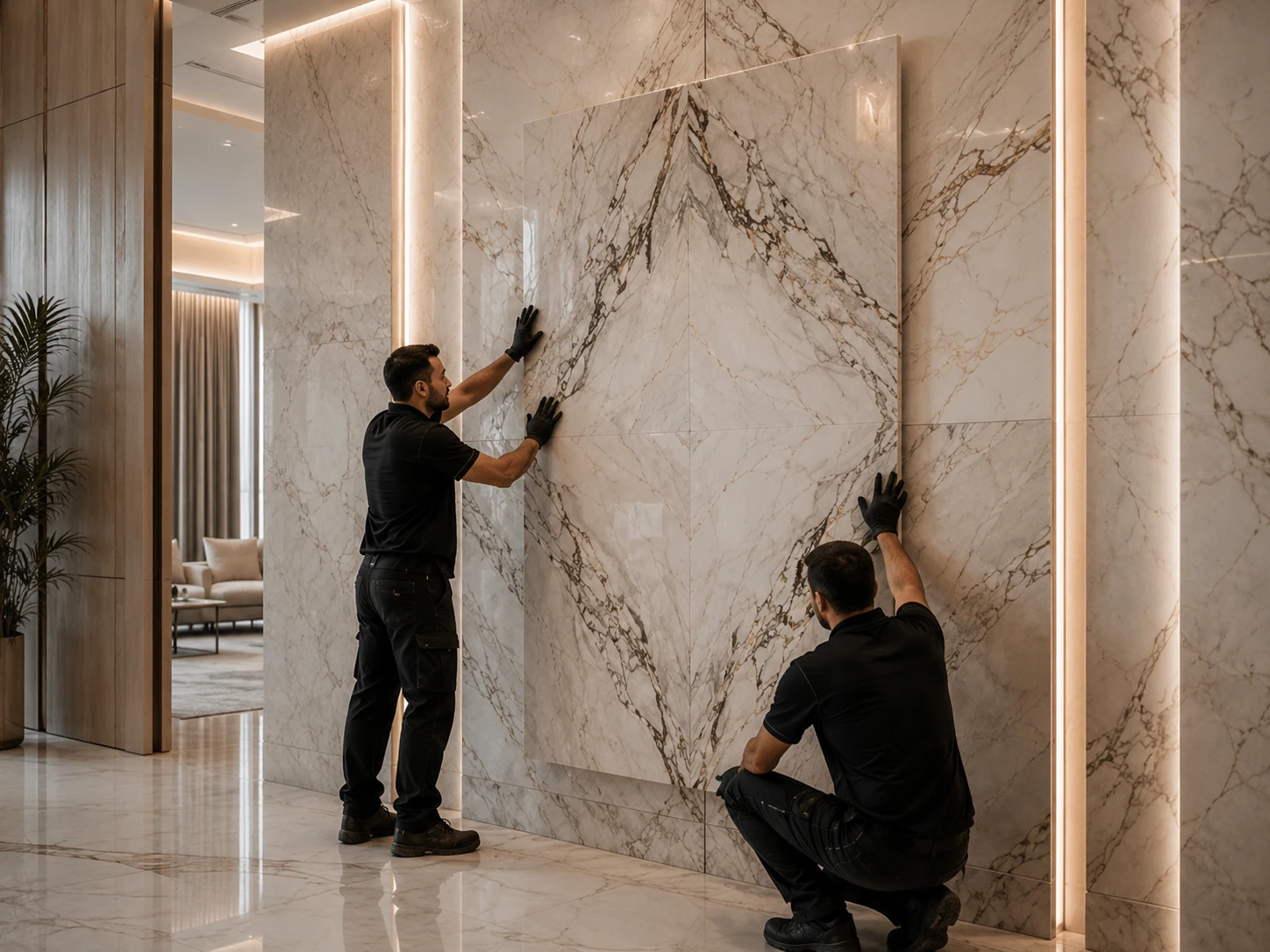
2026 COST SNAPSHOT
What does a book-matched marble wall cost in Dubai?
There is no useful single “per-metre” number unless the quote separates stone, fabrication and fixing.
For a standard natural-stone wall tile installation, current Arifeen Marble guidance is about AED 180–300/m² supplied and fixed. A bookmatched slab wall is a different scope: custom feature-wall fixing alone can sit around AED 180–400+/m², then the selected slabs and fabrication are added.
The stone is normally the biggest variable. Lower-cost marble may start around AED 180–250/m², mid-range imported material around AED 300–450/m², and luxury Italian selections around AED 600–1,200+/m². A specific current bookmatched Calacatta Athena reference from Arifeen Marble is about AED 1,400–1,700/m² material-only, showing how quickly premium slab selection changes the project.
| Cost layer | Indicative 2026 range | What changes it |
|---|---|---|
| Natural-stone wall tiles, supply + fixing | AED 180–300/m² | Tile size, stone, wall condition |
| Custom feature-wall fixing only | AED 180–400+/m² | Slab size, access, alignment, height |
| Lower-cost marble material | AED 180–250/m² | Grade, thickness, finish, stock |
| Mid-range imported marble | AED 300–450/m² | Origin, bundle quality, vein selection |
| Luxury Italian marble | AED 600–1,200+/m² | Rarity, whiteness, veining, slab size |
| Bookmatched Calacatta Athena example | AED 1,400–1,700/m² | Specific matched material selection |
| Protective sealant add-on | AED 25–40/m² | Stone porosity and selected product |
| CAD layout when separately charged | AED 150–300 | Wall complexity and revisions |
Treat these as budgeting references, not a quotation. Bookmatched jobs are often priced by whole slab pairs rather than net wall area.
THE TECHNIQUE
What does “book-matched marble” actually mean?
A true bookmatch starts at the quarry block, not at the installation site.
As a stone block is sawn, consecutive slabs carry related veining because they are adjacent slices through the same geology. One slab is then opened against the next so the pattern mirrors across the joint, similar to opening two pages of a book.
That is different from simply choosing two slabs with similar colours. It is also different from a running or vein match, where the direction continues across panels rather than reflecting around a centreline. If you want the butterfly effect, ask for consecutive slab numbers and approve the exact pair before fabrication.
| Layout | How the veins behave | Best use |
|---|---|---|
| Bookmatch | Mirrored around a centre seam | TV walls, entrances, fireplaces, luxury bathrooms |
| Running / vein match | Movement flows in one direction | Long walls, corridors, countertop runs |
| Random layout | Panels chosen mainly for colour compatibility | Budget cladding or subtle stones |
| Four-way match | Four panels create a larger symmetrical composition | Double-height lobbies and large statement walls |
LAYOUT OPTIONS
Two slabs, four slabs or a running vein: choose the composition before buying stone
The right layout depends on wall proportions more than on the room name.
A two-slab bookmatch works well when a centre seam can sit deliberately behind a TV, artwork, console or fireplace. Four-way matching is more dramatic, but it multiplies the number of seams that must align and usually requires a larger consecutive slab sequence.
For wide walls, a running vein can sometimes look calmer and use the slabs more efficiently. We would rather show you three digital options than force symmetry onto a stone whose natural movement looks better flowing in one direction.
| Composition | Typical visual effect | Budget effect |
|---|---|---|
| 2-panel bookmatch | Strong central butterfly | Lowest bookmatch complexity |
| 4-panel / quad match | Large symmetrical artwork | Higher slab commitment and layout time |
| Running vein | Continuous directional movement | Usually better material yield |
| Mixed panels + borders | Architectural framing | More cutting, edge work and coordination |
Natural stone is not printed wallpaper. The goal is visual balance, not machine-made repetition.
STONE SELECTION
Which marble gives the best bookmatched feature wall?
Bold directional veins usually justify bookmatching; quiet, uniform stones often do not.
If you are still deciding the stone family, our guide to best marble type Dubai explains how white, cream, grey and dark marbles behave across an apartment. For a feature wall specifically, Calacatta, Statuario and Arabescato-style materials create the clearest mirrored centre because the veining is strong enough to read from across the room.
Warm interiors can use beige marble or carefully selected travertine marble when you want movement without a bright-white statement. Darker schemes may use armani grey marble as a reference point, while silver travertine gives a more linear, layered effect.
| Stone look | Bookmatch impact | Indicative material context |
|---|---|---|
| Soft beige / cream | Subtle, calm symmetry | Often AED 180–450/m² depending on stone and grade |
| White grey-veined marble | Classic high-contrast bookmatch | Often AED 600–1,200+/m² for premium Italian selections |
| Premium Calacatta-type selection | Very strong centre composition | Specific matched selections can reach AED 1,400–1,700/m² or more |
| Onyx / translucent stone | Very high visual impact, especially backlit | Commonly quoted separately due to lighting and fragile fabrication |
ROOM PLANNING
Where does bookmatching make sense in a Dubai home?
Spend the premium where you can see the full pattern, not where cabinetry hides half the stone.
Living-room TV walls, formal majlis walls, entrance elevations and fireplace surrounds usually give the best return because the whole composition is visible. In bedrooms, a headboard wall can work if switches, bedside joinery and lighting are coordinated before cutting.
In bathrooms, bookmatched shower or vanity walls can be beautiful, but wet-area build-up and cutouts make planning more demanding; use our bathroom marble tiles Dubai guide before finalising the detail. Where the same renovation also includes stairs, the slab tone can be coordinated with the material used to install marble steps Dubai.
| Location | Why it works | Detail to lock early |
|---|---|---|
| TV wall | Large uninterrupted visual field | TV bracket, conduit, sockets, soundbar |
| Entrance / lobby | Seen immediately and usually front-on | Centreline, console, lighting |
| Fireplace surround | Veins can frame the opening | Heat-safe build-up and panel joints |
| Bathroom feature wall | Luxury effect in a smaller area | Waterproofing, niches, mixers, drains |
| Double-height wall | Maximum visual impact | Access, panel weight, anchoring, scaffold |
MEASURE FIRST
Measure the finished wall—not just the room—before reserving slabs
A 3.0 m × 2.7 m wall is not automatically an 8.1 m² stone order.
We first record the finished width and height, skirting or floor datum, ceiling line, returns, reveals and every penetration. Then we compare those dimensions with the actual usable slab faces, because a beautiful pair may still be too short once damaged edges, resin zones or trimming are excluded.
Bookmatching also changes how waste is understood. You cannot freely rotate every offcut to improve yield because the mirror depends on orientation. In many cases the correct budget is based on buying two complete consecutive slabs even if the finished wall consumes less area.
| Measure | Why it matters |
|---|---|
| Finished wall width / height | Determines whether two slabs can cover the elevation without extra horizontal joints |
| Socket and switch centres | Prevents cutouts from landing on critical veins or seams |
| TV / artwork centreline | Sets the visual centre of the bookmatch |
| Floor and ceiling levels | Avoids uneven top/bottom trimming that makes the pattern look off-centre |
| Returns and side reveals | May require additional stone beyond the front elevation |
SLAB APPROVAL
Approve the actual slab pair and a digital layout before anyone cuts
A sample tells you the colour; only the full slab tells you the composition.
Ask for full-slab photographs taken square-on, the bundle or slab numbers, thickness, finish and visible repairs or mesh backing. The two faces should then be mirrored digitally at the exact wall size so you can see where the main veins meet the centreline and where the top and side trims will fall.
If you are using the same bundle elsewhere, decide that before fabrication. A feature wall may consume the strongest matched pair, while remaining pieces can become a vanity, console or smaller accent; carrying the stone into kitchen countertops is possible, but the cutting plan must protect the feature wall first.
| Approval item | What you should receive |
|---|---|
| Slab identity | Bundle / slab numbers for the reserved pieces |
| Full-face images | Enough resolution to see fissures, resin and vein movement |
| Mirrored preview | Exact wall proportions with proposed centre seam |
| Cutout overlay | Sockets, TV bracket, niches and joinery shown on the stone |
| Offcut plan | Where usable remnants are allocated before cutting |
WHAT HOLDS THE STONE
The wall substrate decides whether adhesive alone is enough
A beautiful slab is still a heavy cladding panel, so fixing design cannot be an afterthought.
For smaller interior stone panels on a suitable flat substrate, a compatible no-slip natural-stone adhesive may be appropriate. Large, thick or high-level panels can require mechanical restraint or an engineered support system depending on panel dimensions, stone properties, wall construction and height.
The Natural Stone Institute's current vertical-surfaces guidance covers both adhesively attached interior veneer and mechanically anchored systems. In practical terms, we inspect the wall for flatness, strength, moisture, movement joints and hidden services before deciding how the panels are supported. White or otherwise non-staining adhesive is commonly preferred for light natural stone where the adhesive manufacturer approves the exact marble.
| Wall condition | What it means for the installation |
|---|---|
| Flat, sound masonry / concrete | May accept bonded stone after correct preparation and specification |
| Gypsum or lightweight partition | Needs load-capacity review and suitable backing / framing |
| Very large or heavy slabs | May require mechanical support or engineered restraint |
| Damp or contaminated wall | Must be corrected before cladding |
| Cracks / movement joints | Cannot simply be hidden behind expensive marble |
COORDINATION
TV brackets, sockets, lighting and joinery should be fixed on the drawing first
The cheapest time to move a socket is before a Calacatta slab has been cut.
For a TV wall, mark the bracket holes, cable conduit, power, data, soundbar and any recessed boxes on the stone layout. If a socket lands exactly on the strongest vein or at the mirrored centre seam, shift the service where possible rather than damaging the visual focal point.
Coordinate adjacent stone details at the same stage. A renovation may also include a marble threshold, natural stone window sills or a commercial raised floor build-up, and those finished levels affect where the wall starts. In kitchens, a separate kitchen countertop installation cost dubai allowance is sensible if the same stone language continues beyond the feature wall.
| Coordination item | Decision before cutting |
|---|---|
| TV bracket | Exact fixing centres and load-bearing backing |
| Sockets / data | Final positions relative to veins and seams |
| LED profiles | Channel depth, driver access and colour temperature |
| Joinery / console | Finished dimensions and stone overlap |
| Skirting / floor build-up | Final datum for bottom cut and shadow gap |
FABRICATION
How the slabs are turned into a matched wall
Fabrication is where the visual concept becomes irreversible.
After approval, the fabricator nests the wall panels on the slab images, preserving the pair sequence and orientation. The slabs are cut, edge-finished and dry-checked before packing. Openings are reinforced and cut with enough clearance for the intended electrical or plumbing component without leaving fragile stone bridges.
The centre seam needs especially careful edge preparation because any chip or bow becomes visible in the mirror. Returns, mitres and exposed edges should be decided at the drawing stage; changing from a square return to a mitred edge after cutting can consume material that was never reserved.
- 01
Scan or photograph the full slabs
Record the real veining and defects before nesting.
- 02
Mirror and position the pair
Set the centre seam and trim zones around the wall dimensions.
- 03
Overlay every cutout
Place sockets, brackets, niches and lighting before cutting.
- 04
Cut and edge-finish
Fabricate panels while preserving the approved orientation.
- 05
Dry-check and label
Confirm sequence, seam relationship and panel numbers before site delivery.
ON SITE
What the installation sequence should look like
Most interior feature walls are measured in days on site, but slab sourcing and fabrication usually take longer than fixing.
For a straightforward two-panel wall with ready stock, site fixing can be relatively quick once fabrication is complete. The total project often takes longer because you must inspect slabs, approve the layout, fabricate panels and coordinate site access. If you are comparing wider scope costs, this tile installation cost UAE guide is useful context, but large-format bookmatched stone should be quoted as specialist work rather than ordinary tile laying.
Our marble installation in dubai workflow follows the same principle: prepare the substrate first, protect the slab sequence, then install from the agreed datum so the central pattern is not corrected by guesswork at the end.
- 01
Protect and prepare the wall
Remove contamination, correct levels and verify the approved fixing substrate.
- 02
Set datums and centreline
Transfer the drawing to the wall before lifting the first panel.
- 03
Dry-position and check
Confirm panel number, top/bottom orientation and seam relationship.
- 04
Fix and support
Apply the specified adhesive and/or mechanical support system, keeping panels in plane.
- 05
Finish joints and clean
Use compatible joint materials, remove residue and complete the final inspection.
REALISTIC EXPECTATIONS
A true natural-stone bookmatch is mirrored—but it is not printer-perfect
This is one of the most important approvals to understand before installation.
The veins inside a marble block exist in three dimensions. Two consecutive slabs are cut at slightly different depths, so the mirrored relationship can be excellent without every fine line meeting the seam like a digitally printed porcelain pattern.
The Natural Stone Institute maintains technical guidance specifically on book-matched marble expectations and notes that exact vein-to-vein coincidence should not be assumed. What you should demand is correct slab sequence, deliberate centreline positioning, consistent joint quality and the best practical alignment of the dominant movement. If exact graphic repetition is your top priority, a printed bookmatch porcelain may actually suit the brief better.
THE PREMIUM
Why bookmatching costs more than standard marble cladding
The premium is not just “luxury markup”; the workflow genuinely consumes more time and often more stone.
A standard wall can rotate and reposition pieces to use the slab efficiently. A bookmatch cannot, because both halves must preserve the mirrored composition. Consecutive slabs may also need to be purchased as a pair even when the net wall is smaller than their combined area.
Current fabrication references commonly use roughly 20–40% as an early bookmatching premium over a comparable standard slab layout. We treat that as a planning allowance, not a fixed charge: a simple full-height two-panel wall may be efficient, while a four-way wall with niches, returns and strict vein-centering can exceed it.
| Cost driver | Why it increases the quote |
|---|---|
| Consecutive slab reservation | You cannot substitute unrelated slabs without losing the mirror |
| Lower layout freedom | Panels cannot be rotated purely to maximise yield |
| Digital / dry layout | More approval and nesting time before cutting |
| Precision fabrication | Centre seam, cutouts and edges receive more attention |
| Handling risk | Damage to one key slab can compromise the matched pair |
| Complex access | Large panels may need extra labour, lifting equipment or protection |
WORKED BUDGET 01
Example: 8 m² living-room bookmatched wall
This is a useful scale for an apartment TV wall or villa lounge feature.
Assume a wall approximately 3.0 m wide × 2.67 m high, with a two-panel bookmatch, normal interior access and no major substrate rebuilding. The first scenario uses a mid-range imported marble; the second uses a premium matched Calacatta-type selection.
These figures are net-area illustrations only. If the approved slabs are larger than the wall, you still buy the required pair, so the actual material line can be higher than 8 m² × the advertised rate.
| Line item | Mid-range example | Premium matched example |
|---|---|---|
| Stone material | AED 2,400–3,600 | AED 11,200–13,600 |
| Custom wall fixing | AED 1,440–3,200 | AED 1,440–3,200 |
| CAD / layout allowance | AED 150–300 | AED 150–300 |
| Sealant allowance | AED 200–320 | AED 200–320 |
| Net-area subtotal | AED 4,190–7,420 | AED 12,990–17,420 |
| Practical planning envelope | About AED 5,000–10,000 | About AED 13,000–18,000+ |
Excludes unusual wall strengthening, access equipment, complex mitres, joinery, lighting, VAT and extra whole-slab area that may be required.
WORKED BUDGET 02
Example: 12 m² statement wall with premium white marble
A wider villa living wall usually needs more careful seam and slab-size planning.
For 12 m², a premium Italian material band of AED 600–1,200+/m² means AED 7,200–14,400+ in stone before the bookmatching constraints are considered. Custom fixing at AED 180–400+/m² adds roughly AED 2,160–4,800, with layout and protective treatment on top.
That produces a simple net-area subtotal around AED 9,810–20,000+ before additional purchased slab area, wall reinforcement, shadow-gap metalwork, LEDs or difficult tower access. If the stone is a selected Calacatta pair priced above the general premium band, the project can move beyond this quickly.
| Cost layer | 12 m² allowance |
|---|---|
| Premium marble material | AED 7,200–14,400+ |
| Custom feature-wall fixing | AED 2,160–4,800+ |
| CAD / layout | AED 150–300 |
| Sealant | AED 300–480 |
| Illustrative subtotal | AED 9,810–19,980+ |
| Safer early budget | AED 11,000–24,000+ after bookmatch/waste risk |
WORKED BUDGET 03
Double-height and four-slab walls need a different level of planning
Once panels become tall, heavy or numerous, access and support design can rival the stone in importance.
A 20 m² double-height feature can consume four or more consecutive slabs depending on slab size and desired symmetry. At AED 600–1,200+/m² for premium material, the net stone alone is AED 12,000–24,000+; custom fixing at AED 180–400+/m² adds AED 3,600–8,000+ before access equipment or engineered support.
In commercial or multi-emirate work, site logistics can be as important as the marble. If you are comparing teams for marble contracting sharjah, ask the same questions you would in Dubai: who approves the slab sequence, who owns the fabrication drawings, and who is responsible for the fixing design.
| 20 m² double-height layer | Early allowance |
|---|---|
| Premium stone, net area | AED 12,000–24,000+ |
| Custom fixing | AED 3,600–8,000+ |
| Layout / sealing | AED 650–1,100 approx. |
| Access / engineered support | Site-specific quotation |
| Practical early envelope | Often AED 18,000–40,000+ depending on slabs and support |
ALTERNATIVE
Natural bookmatched marble or bookmatch porcelain?
Porcelain wins on repeatability and maintenance; natural marble wins on geological depth and one-off character.
Current UAE retail listings show some large-format bookmatch porcelain around AED 150/m² supply-only, although premium slab products and specialist installation can cost more. The printed A/B faces repeat predictably, so the mirrored line can be extremely exact.
Natural marble is less predictable but more individual. No two blocks are identical, and the translucency, mineral movement and depth of a real slab cannot be reduced to one printed pattern. If the wall will be heavily touched, exposed to cleaning chemicals or built on a tighter budget, porcelain can be the practical choice; if the wall is the room's main architectural statement, natural stone usually carries more visual character.
| Factor | Natural marble | Bookmatch porcelain |
|---|---|---|
| Pattern | Unique geological pair | Printed repeatable A/B faces |
| Seam match | Very good but naturally variable | Can be highly exact |
| Material cost | Wide range; premium slabs expensive | Some UAE options start around AED 150/m² supply-only |
| Maintenance | Needs stone-safe care | Generally easier |
| Repairability | Can be honed/polished in many cases | Damaged print/surface usually replaced |
| Luxury character | Natural depth and rarity | Consistent designed appearance |
WET AREAS
Bookmatched marble in bathrooms needs waterproofing behind the stone
The marble surface is the finish; it is not the waterproofing system.
For a shower wall, the substrate, waterproofing, corners, penetrations and compatible stone adhesive must be resolved before the decorative slabs are installed. Niches, mixer bodies and shower outlets should appear on the mirrored slab drawing so they do not destroy the centre composition.
A small matching accessory such as a marble tray can extend the stone language without forcing every surface to be marble. If your bathroom floor is already stone, keep cleaning and sealing decisions consistent with the wider marble maintenance Dubai plan rather than treating the feature wall as an isolated finish.
| Wet-area detail | Why it matters |
|---|---|
| Waterproof membrane | Stops the wall build-up relying on porous stone/grout for water control |
| Penetration sealing | Mixers and outlets are common leakage points |
| Stone-compatible adhesive | Reduces staining / bond problems in sensitive natural stone |
| Movement joints | Allows the assembly to accommodate building movement |
| Finish choice | Polished vs honed changes appearance and maintenance, not waterproofing |
LIGHTING
Backlighting changes the wall from cladding into a lighting system
If the stone is translucent, design the light source before you buy the slabs.
Onyx and some translucent stones can be backlit, but the project then needs a uniform light box, serviceable drivers, ventilation, diffusing layers and enough cavity depth to avoid visible LED hotspots. Current Arifeen Marble material references for backlit onyx panels vary widely, with examples from roughly AED 800–1,800/m² depending on stone and specification.
Front-lighting is simpler for marble. A controlled ceiling wash or narrow-beam spotlight can emphasise veining without introducing the structural and maintenance complexity of a backlit cavity. We recommend testing the actual slab under the intended colour temperature before finalising the room lighting.
| Lighting option | Best for | Extra coordination |
|---|---|---|
| Ceiling wall-wash | Most marble feature walls | Fixture angle and glare |
| Grazing light | Textured / deeply veined stone | Can exaggerate lippage and seams |
| Perimeter LED | Floating panel effect | Profiles, drivers, shadow gap |
| Full backlight | Onyx / translucent stone | Light box, diffusion, ventilation, service access |
AFTER INSTALLATION
How to keep a bookmatched wall looking intentional
A wall sees less abrasion than a floor, but it is still natural stone.
Use a soft cloth and pH-neutral stone-safe cleaner, wipe spills promptly and avoid acidic descalers or aggressive abrasives. If polishing is ever required around a low-level ledge or adjoining floor, our marble floor polishing Dubai guide explains the difference between cleaning, polishing and deeper restoration.
If one panel cracks, diagnose why before replacing it. Repeated movement, hollow bonding or substrate failure is not solved by cosmetic resin. The same decision logic in our repair or replace marble floor UAE guide applies here: preserve sound stone when the problem is local, but correct the underlying system when the defect keeps returning.
| Issue | Likely response |
|---|---|
| Dust / fingerprints | Soft dry wipe, then pH-neutral cleaner as needed |
| Light surface dulling | Professional spot assessment; do not attack with acid |
| Stable chip | Colour-matched resin repair may be possible |
| Crack through one panel | Check substrate and fixing before cosmetic repair |
| Loose / hollow heavy panel | Stop using the area below and inspect the fixing system |
WHOLE-ROOM DESIGN
Use the feature wall as the reference stone, not as an isolated decoration
The best rooms repeat colour and material relationships without copying the same marble everywhere.
Once the feature wall is approved, use its warm or cool undertone to choose adjacent floors, joinery, metal finishes and fabrics. A bold white-and-grey wall may need quieter flooring; a warm beige wall can take darker timber or bronze details without becoming visually busy.
If the project includes loose accessories or secondary stonework, reserve the hero slabs for the wall and use compatible offcuts only where they genuinely fit. The wall should remain the composition customers notice first, rather than losing its strongest vein sections to smaller pieces.
QUOTE CHECKLIST
What should be written into a bookmatched feature-wall quotation?
A proper quote tells you which slabs you are buying and who owns each technical decision.
Ask for slab identification, thickness and finish; net wall dimensions; whether stone is priced by net area or whole slabs; fabrication scope; the approved mirrored layout; fixing method; joint treatment; access assumptions; sealant; cutouts; protection; and exclusions. If the quote says only “marble wall, lump sum,” you cannot compare it properly.
Arifeen Marble's current wall-fixing guidance is useful as a market reference because it separates natural-stone supply/fixing, custom decorative fixing, CAD layout, sealing and other add-ons. Use the same separation when asking anyone to quote your wall.
| Quotation line | What should be clear |
|---|---|
| Stone | Exact slab pair / bundle, thickness, finish, quantity |
| Fabrication | Cutting, polishing, mitres, returns, cutouts, dry layout |
| Fixing | Adhesive / anchors, labour, access, supports |
| Substrate | What preparation is included and what is extra |
| Joints | Width, filler / grout, movement-joint treatment |
| Protection | Sealer, cleaning, protection during remaining fit-out |
| Approvals | Who signs off slab photos and digital layout before cutting |
RESEARCH & SOURCES
What this Dubai bookmatched marble guide is based on
We separate design principles, installation guidance and market pricing so you can see which numbers are budgeting references and which points are technical requirements.
Online prices are useful for budgeting, but the final wall should be quoted from the actual slab pair and substrate. The measured drawing and slab reservation matter more than a generic square-metre rate.
Natural Stone Institute — bookmatch expectations and vertical stone systems
Technical basis for natural bookmatch variation and choosing an appropriate interior cladding or anchoring approach.
View technical library →Arifeen Marble — wall tile and natural-stone fixing guide
Source for AED 180–300/m² natural-stone wall tiles, AED 180–400+/m² custom fixing, CAD layout and sealant references.
View Arifeen Marble guide →Arifeen Marble — matched Calacatta pricing example
Specific reference showing bookmatched Calacatta Athena around AED 1,400–1,700/m² material-only.
View material reference →UAE technical guidance for large-format natural stone
Confirms that adhesive choice depends on stone, size, substrate and application, with no-slip systems for walls.
Review technical guidance →Current fabrication reference for bookmatching premiums
Supports roughly 20–40% as an early planning allowance where slab commitment, layout time and waste increase.
Review fabrication reference →Current UAE bookmatch porcelain retail reference
Used only to compare with printed A/B slabs currently listed around AED 150/m² supply-only.
View porcelain reference →