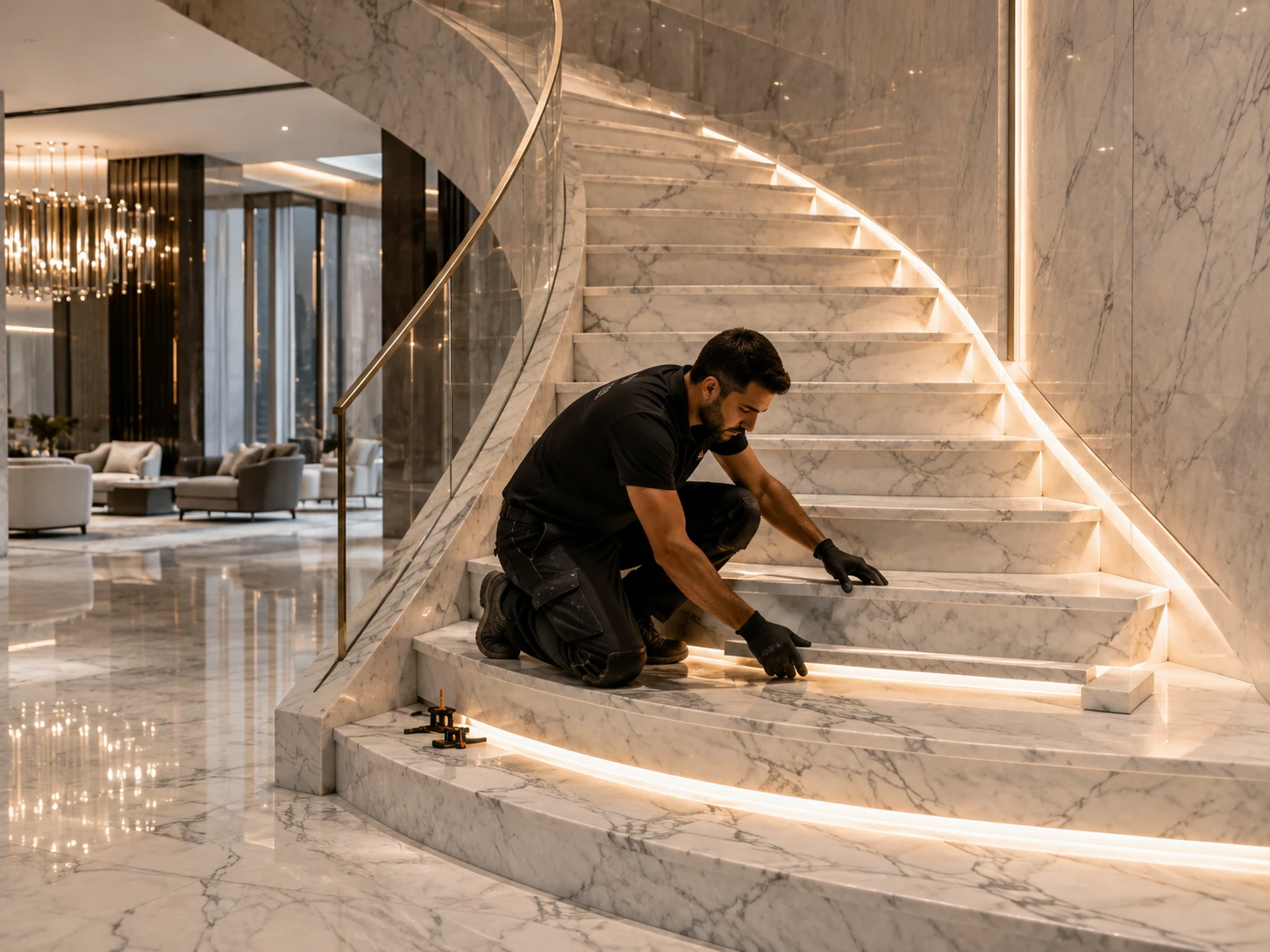
2026 PRICE SNAPSHOT
How much does a marble staircase cost in Dubai?
For an existing concrete flight, per-step pricing is more useful than a floor-style AED/m² rate because each tread needs individual fabrication and alignment.
A practical 2026 starting point is AED 350–700 per step for straightforward marble cladding where the concrete stair is sound and the scope includes a tread, riser and standard nosing. More custom marble or stone cladding is often budgeted around AED 450–1,200 per step, while premium material, wide treads, curved geometry, slab vein matching, mitred build-ups and lighting channels can push individual steps toward AED 1,200–2,000+.
Those bands should not be confused with the raw stone rate. Standard marble can start around AED 60–120/m², mid-range Turkish or Greek stone around AED 120–250/m², and premium Italian selections around AED 350–900+/m². Stair fabrication adds cuts, returns, nosing pieces and vein selection, so the finished rate is higher than the visible stone area alone.
| Staircase level | Indicative 2026 rate | Typical scope | 15-step planning total |
|---|---|---|---|
| Straight / standard cladding | AED 350–700 per step | Tread + riser + standard nosing on sound concrete | AED 5,250–10,500 |
| Custom marble / stone cladding | AED 450–1,200 per step | Better stone, custom widths, profiles, detailed fabrication | AED 6,750–18,000 |
| Premium staircase | AED 1,200–2,000+ per step | Rare marble, curves, wide treads, book-matching, mitres, lighting details | AED 18,000–30,000+ |
| Landing areas | Usually measured separately | Natural stone supply/fix, cuts, border alignment, polishing | Add to flight total |
| Balustrade / handrail | Usually measured separately | Glass, metal, timber or combined system | Add by linear metre / design |
These examples assume the structural staircase already exists. A new steel, cantilevered, floating or helical structure is a separate engineering and fabrication project.
WHAT YOU ARE ACTUALLY PAYING FOR
Why marble stairs are priced per step even when marble is sold per square metre
A staircase has more fabrication edges and more geometric constraints than a flat floor, so the visible stone area tells only part of the cost story.
Each step normally has at least a tread and riser, and many designs add a separate nosing, mitred downstand, side return or anti-slip detail. The fabricator also has to maintain consistent widths, check the vein direction, polish exposed edges and keep every finished riser within the stair geometry. That is why an installer can quote a staircase per step even though the slab itself is bought per square metre.
Arifeen Marble's tile installation cost UAE guide gives a useful flat-surface reference: natural stone supply-and-install work is broadly AED 120–400/m² and large-format/natural-stone labour-only work is around AED 45–55/m². Stair work sits above a simple floor rate when cutting, profiles, templating and individual piece handling increase the labour.
| Cost component | How it is measured | What increases the price |
|---|---|---|
| Treads | Per step / cut-to-size | Extra width, depth, thick build-up, exposed ends |
| Risers | Per step / cut-to-size | Vein matching, book-matched effect, thin joints |
| Nosing / front edge | Per step | Bullnose, pencil edge, mitred drop, grooves, metal insert |
| Landings | m² or cut-to-size package | Borders, diagonal layout, slab matching, large pieces |
| Side skirting / stringer stone | Linear metre / piece | Curves, stepped profiles, mirrored sides |
| Preparation | m² or lump sum | Broken screed, irregular risers, hollow existing tiles, demolition |
STONE SELECTION
Which marble should you choose for staircase treads and risers?
The best staircase stone is not simply the whitest or most expensive slab; it has to suit traffic, finish, edge fabrication and the amount of natural variation you want to see across repeated steps.
Carrara is often the entry point for an Italian white-marble look because its grey veining is usually softer and easier to repeat across a full flight. Calacatta and Statuario create a more dramatic luxury staircase, but slab selection and vein planning matter much more because every tread can become a visible design line. Warm cream and beige marble can be forgiving in busy family interiors because dust and small tone changes are less visually sharp than on pure white stone.
Darker projects may use a grey stone such as armani grey marble, although dark polished surfaces can show dust, footprints and fine abrasion more quickly under strong lighting. If you prefer a textured natural-stone look, travertine marble and silver travertine are worth comparing, particularly where a honed or textured finish is part of the design rather than a mirror-polished stair.
| Stone direction | Why customers choose it | What to check before approval |
|---|---|---|
| Carrara / softer white-grey | Classic, lighter, usually more attainable than statement Italian slabs | Batch consistency, grey vein density, tread finish |
| Calacatta / Statuario | High-contrast luxury focal staircase | Slab-by-slab selection, vein continuation, wastage |
| Cream / beige marble | Warm villa interiors, softer visual maintenance | Tone variation, resin fills, edge colour |
| Grey marble | Contemporary interiors, strong contrast with light walls | Scratch visibility, polishing consistency, edge appearance |
| Travertine | Textured, architectural, warm natural appearance | Filling quality, holes, finish, slip performance, sealing |
GEOMETRY & CODE
Do not let new marble make the staircase geometry worse
The biggest technical mistake in stair cladding is measuring the concrete step without checking the final floor levels above and below the flight.
Dubai Building Code states that stair riser height is generally 100–180 mm and tread depth must be at least 280 mm. For regular-use stairs, the code recommends a 150–165 mm riser and tread depth of at least 300 mm. It also requires risers and treads within a flight to be as uniform as possible, with no more than 10 mm difference in a single flight.
Marble thickness, bedding, adhesive and the finished landing floor can all alter the first or last riser. If the upper landing receives 20 mm of new stone but the stair flight is measured before that build-up is allowed for, the final top riser can become noticeably different. We therefore measure the full flight from finished level to finished level before releasing fabrication, especially on renovation work.
| Dubai stair item | Code reference | Why it matters to marble cladding |
|---|---|---|
| General riser height | 100–180 mm | Stone build-up must not create an abnormal first or last riser |
| Minimum general tread depth | ≥280 mm | Nosing and cladding must preserve usable tread depth |
| Regular-use recommended riser | 150–165 mm | Comfortable daily circulation target where applicable |
| Regular-use recommended tread | ≥300 mm | Provides a deeper stepping surface |
| Variation within one flight | ≤10 mm | Fabrication and fixing must keep steps consistent |
| Minimum stair headroom | 2,030 mm | Finish changes should not compromise clear headroom |
The applicable approval route depends on the building and scope. Structural changes, new staircases and means-of-egress work require project-specific professional/code review rather than finish guidance alone.
SAFETY DETAIL
Polished marble looks luxurious, but the tread edge and surface traction need deliberate design
A staircase is a walking surface with repeated level changes, so finish selection should be treated differently from a polished feature wall.
Dubai Building Code requires stair treads and landings in the same stairway to have consistent surface traction. For regular-use stairs, the step edge should also present a slip-resistant surface with visual contrast. That makes the front edge a functional detail: grooves, an integral contrasting strip, a properly specified insert or a more textured finish can help make the edge easier to read and safer underfoot.
Natural-stone slip behaviour depends on both the stone and the finish, so labels such as polished, honed or brushed are not a substitute for product data where slip performance is critical. Natural Stone Institute guidance also notes that stone used as a walking surface may require slip-resistance and abrasion testing depending on the application.
| Finish / edge option | Visual effect | Practical note | Typical cost effect |
|---|---|---|---|
| Polished tread | Highest gloss, strongest vein depth | Can become more slippery; assess actual traction | Usually standard/premium finish |
| Honed tread | Lower sheen, softer appearance | Often preferred where less gloss is desired; still verify traction | Usually modest finish change |
| Machined anti-slip grooves | Visible linear detail near nosing | Adds tactile/visual cue and fabrication time | Often priced per step |
| Contrast / anti-slip nosing detail | Defines leading edge | Published 2026 allowances are roughly AED 30–80/step for basic strips/details | AED 30–80/step planning allowance |
| Textured stone finish | More architectural / matte | Can improve grip but changes cleaning and appearance | Stone/finish-specific |
MEASUREMENT FIRST
We measure every tread, riser, landing and exposed side before cutting the staircase
Even a staircase that looks straight can have small variations in width, riser height, wall line and landing level that become obvious once crisp marble pieces are installed.
Final measurement records each tread depth, riser height, step width, side condition, wall deviation, landing size and finished-floor relationship. We also confirm whether the stair has an exposed outer end, a wall-side skirting piece, a glass-channel zone, a handrail fixing zone or lighting channels that cannot be cut after installation without risking the marble.
Renovation work needs more coordination because the staircase may meet new flooring at both ends. A marble threshold can resolve a deliberate transition at a doorway or landing, but it should not be used to hide a badly planned level difference. If the wider villa also includes natural stone window sills, we recommend approving the stone tone and finish together so the staircase does not feel disconnected from the other fixed stonework.
| Measurement | Why we record it |
|---|---|
| Finished floor-to-floor height | Controls the final riser sequence |
| Every tread depth | Detects irregular concrete before cutting |
| Every stair width | Prevents gaps against walls or exposed returns |
| Landing dimensions | Coordinates slab/tile layout and vein direction |
| Outer exposed edges | Determines return, mitre or polished end detail |
| Railing / glass fixings | Avoids drilling conflict with stone joints and weak edges |
FROM SURVEY TO HANDOVER
What the marble staircase installation process actually involves
A standard flight can move quickly once dimensions and stone are approved, but the fabrication stage is where good stairs are won or lost.
| Project type | Practical planning timeline | Main variable |
|---|---|---|
| Straight flight, stock stone | About 1–3 weeks from final measure/approval | Workshop queue, stone availability, site readiness |
| Custom curved / large-format flight | Often 2–4+ weeks | Templates, fabrication complexity, slab matching |
| On-site installation | Usually a few days for a standard flight | Step count, preparation, access, cure/protection time |
| Full new structural staircase | Project-specific and longer | Engineering, structure, railing, approvals, fabrication |
Published Dubai staircase installers commonly quote around two to three weeks for a marble staircase process, while full bespoke staircase projects can run longer. Treat timeline as a planning range until the stone and site are confirmed.
- 01
Site survey and geometry check
Measure finished levels, each tread/riser, landings, wall lines, exposed ends, access and any defects in the existing concrete or old stone.
- 02
Stone and finish approval
Approve the marble batch, finish, vein direction, nosing profile, joint approach and whether side skirting, grooves or lighting channels are required.
- 03
Cut list and dry planning
Translate the staircase into individual fabricated pieces and sequence the slabs so colour and veining do not jump randomly from step to step.
- 04
Workshop fabrication
Cut treads and risers, form the specified edge profile, polish visible edges and pre-check critical dimensions before dispatch.
- 05
Preparation and installation
Remove unsound finishes if required, correct the base, install pieces in sequence with a compatible fixing system and maintain consistent finished risers.
- 06
Joints, finishing and protection
Complete grout/sealant details, clean the stone, apply the specified protective treatment where appropriate and protect the flight from following trades.
INSTALLATION QUALITY
Why marble stairs are harder to install than ordinary floor tiles
A stair tread has to carry traffic at its front edge while also reading as one repeated architectural line across the whole flight.
Natural marble is heavy, brittle at thin edges and visually unforgiving when one piece sits higher than the next. Cutting too aggressively can chip the nosing; poor support can leave hollow zones; inconsistent bedding changes riser heights; and the wrong adhesive system can contribute to staining or movement in moisture-sensitive stone. A staircase also has far more exposed edges than a floor, so workshop finishing quality is visible from several angles.
Technical natural-stone installation guidance recommends selecting adhesives according to the stone type, size, substrate and moisture sensitivity. Some light or moisture-sensitive stones benefit from white and/or rapid-setting systems that reduce the time moisture remains behind the piece. The installer should therefore approve the fixing system after the actual marble has been selected rather than treating every stone like ceramic tile.
- Check the concrete or screed for cracks, hollow areas, weak edges and major level differences before fixing.
- Dry-plan natural colour and vein variation before the pieces are permanently installed.
- Provide full, reliable support under the tread and particularly near the nosing where impact is concentrated.
- Keep joint widths and riser heights consistent from the first step to the final landing.
- Use cutting, drilling and edge-finishing methods appropriate for natural stone rather than general masonry work.
RENOVATION DECISION
Should you reclad the staircase, replace individual marble pieces or restore what is already there?
If the existing marble is secure and the problem is mainly dullness, scratches or minor edge damage, replacement may be unnecessary.
A staircase with sound, well-bonded marble can often be restored through local repair, grinding/honing where appropriate, edge repair and repolishing. Replacing every step makes more sense when many pieces are loose or shattered, the design is changing, the underlying geometry is poor, or repeated cracking points to a substrate problem that must be corrected before new stone is fitted.
The same diagnostic logic applies to floors. Our guide on repair or replace marble floor UAE explains where surface restoration stops and replacement becomes the more sensible route. For stairs, the extra question is whether the existing treads and risers can be repaired without creating inconsistent step heights or visibly mismatched pieces.
| What you see | Likely route | Before you approve work |
|---|---|---|
| Dull, scratched but firmly bonded marble | Restore / repolish | Check edge damage and traction requirements |
| One or two chipped pieces | Local repair or matched replacement | Confirm colour/vein match and finished height |
| Repeated cracks in same location | Investigate substrate first | Do not simply replace the stone again |
| Many hollow or loose treads | Remove and assess base | Confirm geometry before refabrication |
| Complete design change | Reclad / replace | Coordinate landings, railings and new finish thickness |
DESIGN COMPLEXITY
Straight, curved and floating marble stairs do not belong in the same price bracket
A straight concrete flight is primarily a cladding and fabrication job; a floating or helical staircase can become a structural design project before the marble is even discussed.
Straight closed-riser stairs are usually the most economical because tread and riser shapes repeat. L-shaped or U-shaped stairs add landings and more visible junctions, while curved stairs need individual templates and non-repeating pieces. Open-riser stairs change the edge treatment because the underside of each tread can remain visible.
Cantilevered or floating steps need structural confirmation of the supporting system and cannot be priced as ordinary marble cladding. Stone thickness, backing, reinforcement and attachment all depend on the engineered stair design. If your project is simply covering an existing concrete flight, say that clearly when requesting a quote; it prevents a contractor from comparing your job with a completely new structural staircase.
| Stair type | Relative fabrication complexity | Typical pricing behaviour |
|---|---|---|
| Straight closed-riser concrete flight | Lowest | Often fits AED 350–700/step starting band |
| L / U shape with landings | Medium | More landing layout, cuts and transitions |
| Curved stair | High | Individual templates and non-repeating fabrication |
| Open-riser stair | High | More exposed edges and underside finishing |
| Cantilever / floating | Very high | Structural design + bespoke tread build-up |
| Helical / statement staircase | Very high | Custom structure, curved geometry, premium fabrication |
WORKED BUDGETS
What 12, 15 and 18 marble steps can cost before the extras
The examples below isolate the tread-riser package first, then show which items you should add separately so the budget does not look artificially low.
For a straight flight using the AED 350–700 per-step planning band, 12 steps work out at AED 4,200–8,400, 15 steps at AED 5,250–10,500 and 18 steps at AED 6,300–12,600. A custom AED 450–1,200 per-step specification moves those same flights to AED 5,400–14,400, AED 6,750–18,000 and AED 8,100–21,600 respectively.
Premium stairs should be budgeted differently because material selection, slab yield and detailing dominate the price. At AED 1,200–2,000+ per step, a 15-step statement flight is approximately AED 18,000–30,000+ before a landing, balustrade, lighting, demolition or base correction is added.
| Step count | Straight / standard AED 350–700 | Custom AED 450–1,200 | Premium AED 1,200–2,000+ |
|---|---|---|---|
| 12 steps | AED 4,200–8,400 | AED 5,400–14,400 | AED 14,400–24,000+ |
| 15 steps | AED 5,250–10,500 | AED 6,750–18,000 | AED 18,000–30,000+ |
| 18 steps | AED 6,300–12,600 | AED 8,100–21,600 | AED 21,600–36,000+ |
Add landings, skirting/stringer pieces, railing, demolition, substrate repair, transport/access and any lighting/electrical scope separately unless the quotation explicitly says they are included.
THE EXTRAS PEOPLE MISS
Landings, skirting, demolition, lighting and balustrades can materially change the final staircase price
The per-step rate is useful only when you know which surrounding details are excluded from it.
Old finish removal can start from about AED 50/m² on straightforward flat-surface renovation work, while levelling or screeding is commonly around AED 20–40/m² in current UAE guides. Stair demolition and rebuilding are usually more labour-intensive than flat floors, so damaged risers or edges should be inspected and priced as a staircase repair rather than automatically applying the flat rate.
A glass balustrade is normally a separate specialist package; 2026 Dubai market guides commonly show roughly AED 600–1,500 per linear metre for many glass/metal railing systems, with premium frameless specifications higher. Integrated LED lighting can also add electrical wiring, channels, drivers, access panels and coordination with the stone fabrication. Those details should be frozen before the tread pieces are cut.
| Extra | 2026 planning reference | How to treat it in the quote |
|---|---|---|
| Old tile/stone removal | From ~AED 50/m² flat-surface reference | Stair hand-demolition may be higher; quote separately |
| Levelling / screed correction | ~AED 20–40/m² flat-surface reference | Use only for suitable preparation; broken risers may need lump-sum repair |
| Anti-slip nosing detail | ~AED 30–80/step basic planning allowance | Confirm material, fixing method and appearance |
| Glass balustrade | ~AED 600–1,500/lm common market band | System, glass specification and hardware change the rate |
| LED step lighting | Often quoted per step / point | Coordinate channels before stone fabrication |
| Landing marble | Use material + fabrication/installation basis | Do not assume it is included in the step rate |
WHOLE-PROPERTY COORDINATION
If the staircase is part of a villa renovation, coordinate the stone before the other fixed finishes are ordered
A staircase sits at the junction between floors, walls, railings and rooms, so it can expose inconsistent material choices faster than almost any other feature.
If the same renovation includes bathroom marble tiles Dubai, decide whether you want the stair stone repeated in bathroom details or whether the bathrooms should deliberately shift to a different palette. Similar coordination helps when selecting kitchen countertops because a very busy countertop and a heavily veined staircase can compete visually in an open-plan villa. For budgeting the kitchen separately, use a dedicated kitchen countertop installation cost dubai reference instead of burying that scope in the staircase quote.
Small stone details also benefit from deliberate coordination. A marble tray is decorative rather than structural, but matching or contrasting it with the selected bathroom and staircase palette can make the interior feel more intentional. In commercial interiors, a raised floor may meet the stair landing at a finished level, so that build-up must be known before final riser dimensions are released.
LOCATION & ACCESS
Dubai staircase pricing also changes with access, delivery and where the fabrication team has to work
A staircase inside an occupied villa with easy ground-floor access is a different installation from a tower duplex with booking slots, lift restrictions and limited stone storage.
Dubai projects can sit toward the higher end of UAE installation rates because parking, loading access, building procedures and work-hour restrictions add handling time. Stair pieces are especially sensitive to logistics because long treads and polished edges need protection from the workshop to the final flight; repeated carrying through tight corridors increases both labour and breakage risk.
If you are comparing a project outside Dubai, make sure the quote includes travel, transport and the number of site visits rather than comparing the headline step rate alone. Customers working in another emirate may also review specialist marble contracting sharjah information for regional context, while our own marble installation in dubai service route is the relevant starting point for Dubai marble fixing and staircase enquiries.
BEFORE YOU APPROVE
What a proper marble staircase quotation should include
If the quote says only “15 marble steps × AED ___,” you still do not know enough to compare it fairly.
For a useful site quotation, send us the total step count, approximate stair width, photos from the bottom/top/side, landing sizes, project location, preferred marble and whether the existing stair is bare concrete or already clad. That is enough to decide whether the next step is a preliminary range or a measurement visit.
- Exact step count, tread widths, tread depths, riser heights and landing areas.
- Marble name/selection, grade, thickness, finish and whether the stone is client-supplied or contractor-supplied.
- Whether the price includes tread, riser, nosing, side returns, exposed edges and stair skirting/stringers.
- Nosing profile: square, pencil, bullnose, mitred drop, groove detail or integral anti-slip strip.
- Demolition, disposal, substrate repair, levelling and correction of broken concrete edges.
- Adhesive/fixing approach appropriate to the selected natural stone and substrate.
- Vein direction, slab sequencing, colour variation acceptance and any book-matching requirement.
- Landing layout, thresholds, joints, movement details and interface with upper/lower finished floors.
- Railing/glass interface, drilling responsibility, lighting channels and electrical exclusions.
- Delivery, internal handling, access restrictions, protection, final cleaning, VAT and warranty/exclusions.
AFTER INSTALLATION
How to keep marble stairs looking good without making them slippery
The maintenance goal is to remove abrasive grit and spills without leaving a waxy film or chemically attacking the marble.
Natural Stone Institute care guidance recommends frequent dust removal because sand, dirt and grit are abrasive. That matters in Dubai, where tracked particles can wear the tread centre and nosing faster than low-traffic floor areas. Use a clean dry dust mop or soft cleaning method, then damp-clean with a pH-neutral stone-safe product rather than acidic bathroom cleaners or aggressive descalers.
Sealing is not the same as creating a slip-resistant coating, and not every stone requires the same treatment interval. The sealer should be selected for the specific marble and finish, then maintained according to actual absorption and use. If a stair becomes dull, do not simply add a glossy topical product; first identify whether the problem is abrasion, etching, residue or previous coating build-up.
| Maintenance task | Recommended approach | Avoid |
|---|---|---|
| Daily / regular dust | Soft dry dust removal | Letting sand and grit grind under shoes |
| Routine cleaning | pH-neutral stone-safe cleaner | Acidic descalers, vinegar, harsh abrasive cleaners |
| Spills | Blot and clean promptly | Leaving coloured/acidic liquids on the tread |
| Loss of shine | Assess polish/etching/abrasion first | Waxing over the problem without diagnosis |
| Sealing | Stone-specific penetrating treatment if beneficial | Assuming every marble needs the same calendar interval |
RESEARCH & SOURCES
What this marble staircase guide is based on
Local price bands, Dubai stair geometry and natural-stone performance were checked separately so a market quote is not presented as a building-code requirement.
Commercial staircase price guides do not publish identical rates, so this article uses overlapping 2026 market bands instead of presenting one advertised number as a universal price. Once your step count, widths, stone, profile, landings and substrate are measured, a site-specific quotation should override any internet range.
Dubai Building Code — stair geometry, surfaces and handrails
Used for the 100–180 mm general riser range, ≥280 mm tread minimum, regular-use recommendations, uniformity and stair-surface requirements.
Open official code page →Arifeen Marble — 2026 UAE installation cost guide
Used for general natural-stone supply/install, demolition, levelling and regional pricing context.
Open price guide →Natural-stone care and maintenance guidance
Used for abrasive grit, cleaning and stone-care recommendations after installation.
Open care guidance →Natural-stone testing and slip-resistance guidance
Used for the point that walking-surface stone may need application-specific slip and abrasion data rather than relying on a finish name alone.
Open testing guidance →Technical guidance for natural-stone adhesives
Used to cross-check that adhesive selection depends on stone type, format, substrate and moisture sensitivity.
Open technical reference →Current Dubai staircase materials and cost reference
Used to cross-check per-step natural-stone, anti-slip and staircase design pricing bands.
Open market reference →