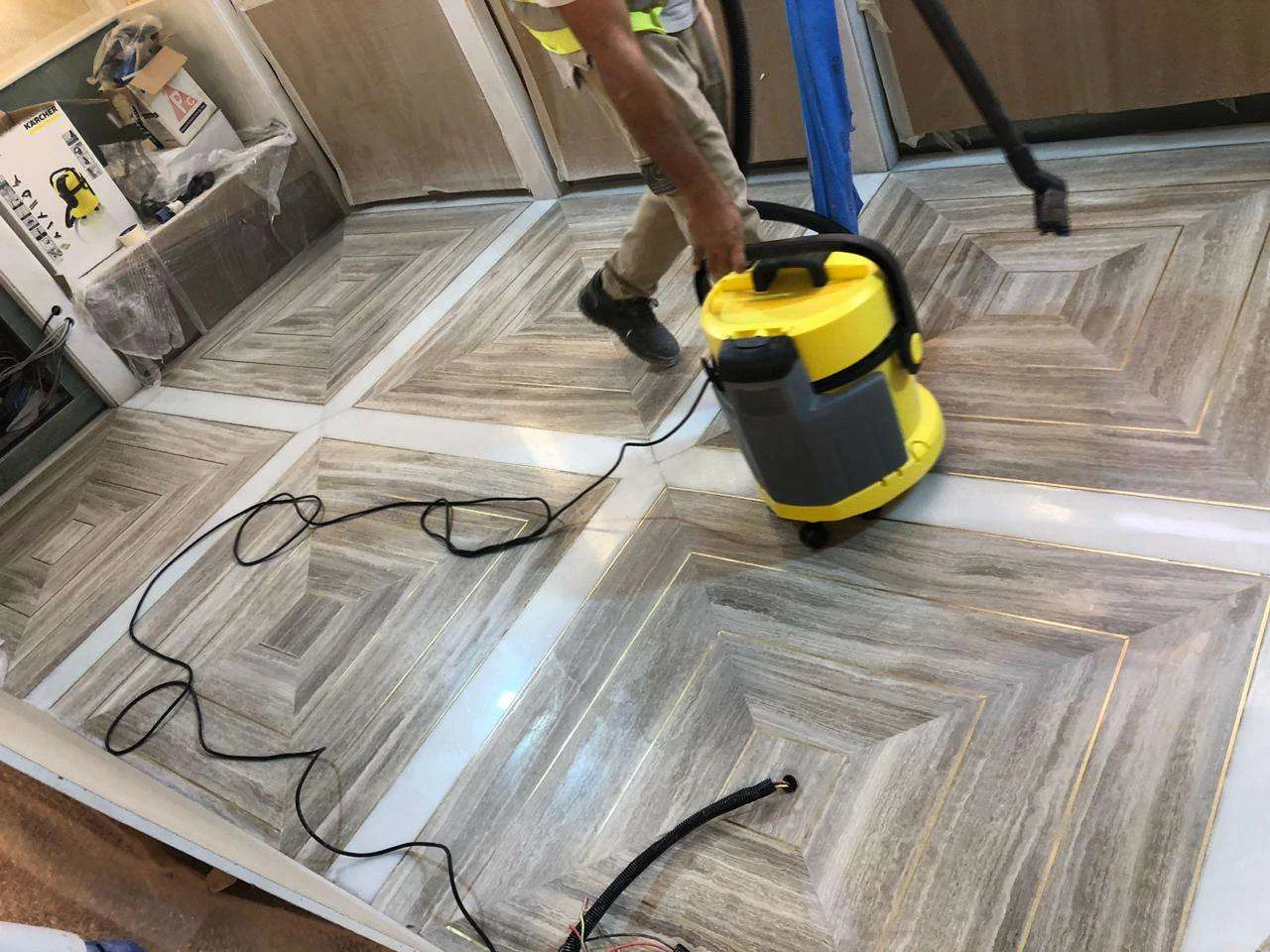
2026 PRICE BREAKDOWN
How much does marble floor polishing cost in Dubai?
The realistic answer is a band, not one price: current Dubai guides overlap from roughly AED 15/m² for simple maintenance to AED 300+/m² for difficult premium restoration.
For a floor that is already flat and only lacks shine, routine polishing is commonly budgeted at AED 15–50/m². Light machine or diamond work often sits around AED 35–60/m², while grinding and re-polishing for visible scratches or minor lippage commonly moves to AED 55–90/m².
A full restoration normally starts higher because it combines several abrasive stages, localized repairs, edge work and final finishing. Current 2026 market references commonly place that scope around AED 90–150/m²; intricate patterns, delicate imported stone, severe damage or high-spec work can reach AED 150–300+/m².
| Service level | 2026 planning range | Best for | Usually includes |
|---|---|---|---|
| Routine polish / refresh | AED 15–50/m² | Dull but otherwise healthy marble | Cleaning, light polishing or buffing; exact process varies |
| Light diamond polish | AED 35–60/m² | Fine wear, light scratching, uneven gloss | Fine diamond stages and polishing |
| Grinding + re-polish | AED 55–90/m² | Deeper scratches, etching, minor lippage | Coarser correction followed by honing/polishing |
| Full restoration | AED 90–150/m² | Neglected or visibly damaged floors | Multiple diamond stages, local repairs, edge work and final finish |
| Premium / complex restoration | AED 150–300+/m² | Rare stone, intricate patterns, severe damage | Slower specialist work, detailed edges and repairs |
A quotation that says only “marble polishing” is incomplete. Ask which stages are included and whether grinding, edges, crack filling, crystallization and sealing are separate.
START WITH THE SYMPTOM
Dullness, etching, scratches, stains and lippage are different problems
We do not recommend the same machine sequence for every floor because the visible defect tells us how deep the correction has to go.
A dull traffic lane can be simple surface wear. Acid etching is a chemical attack on calcite-rich marble, so it normally needs refinishing rather than stronger cleaning. A stain is absorbed material and may need a poultice or stain-specific treatment before any polishing work.
Deep scratches and lippage are mechanical defects. The Natural Stone Institute advises that deeper scratches and nicks should be repaired and re-polished professionally, while persistent efflorescence can indicate moisture movement and should not be hidden with a glossy finish.
| What you see | Likely first treatment | What polishing alone cannot fix |
|---|---|---|
| Uniform dullness | Maintenance polish / fine honing | Structural cracks or loose tiles |
| Cloudy acid etch | Honing + polishing | Absorbed stain below the surface |
| Fine scratches | Fine diamond honing + polish | Deep gouges that need heavier correction |
| Scratch catches a fingernail | Grinding / heavier honing + polish | Active movement below the tile |
| Uneven tile edges / lippage | Grinding / flattening | A failed or moving substrate |
| Dark or coloured stain | Stain-specific treatment first | Etching caused by acid |
| White powder / recurring salts | Moisture diagnosis | Source of moisture below the stone |
THE PROFESSIONAL PROCESS
What actually happens when we restore the shine
A proper result is built in stages. The glossy final pass cannot compensate for skipped correction work underneath.
- 01
Inspect and test
We identify the stone, finish, stains, etching, scratches, cracks, hollow areas and lippage, then choose a small test area where needed.
- 02
Protect the room
Skirting, doors, joinery and adjoining finishes are protected. Furniture movement, access and wet-slurry control are agreed before machines start.
- 03
Repair before finishing
Stable chips, open joints or local cracks are repaired where appropriate. Recurring cracks or loose tiles are diagnosed instead of being cosmetically hidden.
- 04
Grind only when required
Coarser diamond tooling removes deep damage and can flatten lippage. A good floor does not need aggressive grinding simply because a machine is available.
- 05
Hone through finer stages
Progressively finer abrasives remove the previous scratch pattern and build a uniform, smooth surface ready for the chosen sheen.
- 06
Polish and finish
The stone is polished to the agreed gloss or satin level. Crystallization may be used on suitable marble when specified; sealing is a separate protection decision.
DO NOT CONFUSE THE STAGES
Grinding, honing, polishing, crystallization and sealing do different jobs
These words are often bundled together in advertisements, which makes two quotations look comparable when they may describe completely different work.
The Natural Stone Institute describes penetrating products as impregnators rather than a waterproof film: they improve stain resistance but do not make the stone stain-proof. Acidic liquids can still etch marble even after sealing.
| Stage | Purpose | When you need it | What it does not do |
|---|---|---|---|
| Grinding | Removes more stone and flattens damage | Deep scratches, lippage, severe surface failure | Does not create the final gloss by itself |
| Honing | Refines the scratch pattern to a smooth matte/satin surface | Etching, moderate wear, preparation for polish | Does not repair loose stone or substrate movement |
| Polishing | Raises reflectivity on a properly prepared surface | Dullness or final finishing after honing | Does not erase deep defects that were never honed out |
| Crystallization | Optional chemical/mechanical finish on suitable calcareous stone | High-gloss finish where the stone and specification suit it | Not a substitute for grinding, honing or stain treatment |
| Impregnating sealer | Improves resistance to absorbed staining | Porous stone where testing shows benefit | Does not make marble acid-proof or stop etching |
WORKED PROJECT BUDGETS
What 40, 80, 150 and 250 square metres can cost
These totals are simple area calculations using the published 2026 planning bands, so they help you sense-check a quote before site-specific extras are added.
A current Dubai guide gives a 40 m² living-area example around AED 900–2,000 for ordinary polishing, which sits inside the wider planning bands above. Once deep correction is required, the price is driven more by the number of abrasive stages than by floor area alone.
| Floor area | Routine polish AED 15–50/m² | Light diamond AED 35–60/m² | Full restoration AED 90–150/m² |
|---|---|---|---|
| 40 m² | AED 600–2,000 | AED 1,400–2,400 | AED 3,600–6,000 |
| 80 m² | AED 1,200–4,000 | AED 2,800–4,800 | AED 7,200–12,000 |
| 150 m² | AED 2,250–7,500 | AED 5,250–9,000 | AED 13,500–22,500 |
| 250 m² | AED 3,750–12,500 | AED 8,750–15,000 | AED 22,500–37,500 |
Small jobs may not follow pure area arithmetic because mobilization, protection and machine setup still take time. Large open floors can sometimes achieve a lower unit rate than small, heavily divided rooms.
WHAT MAY BE EXTRA
Crystallization, sealing, spot treatment and minimum call-out charges
Ask for extras to be itemized because a low per-metre headline can become a very different final bill after finishing treatments are added.
Do not automatically buy every add-on. Crystallization is a finish choice for suitable marble, and sealing should be based on the stone's absorption and use. If the real problem is a deep scratch, neither treatment replaces proper abrasive correction.
| Possible extra | Indicative planning range | How to read it |
|---|---|---|
| Crystallization | AED 10–50/m² | Published add-on ranges vary with product, stone and whether it is bundled |
| Simple impregnating sealer | AED 5–15/m² | Basic published add-on range; specialist systems can cost more |
| Localized etch / stain treatment | AED 80–200 per affected area | Usually priced per spot rather than across the whole floor |
| Small-job mobilization | About AED 350–500 minimum | Current UAE service references show minimum project pricing in this zone |
| Crack / chip / grout repair | Site-specific | Depends on quantity, depth, colour matching and whether movement is active |
| Furniture / restricted access | Site-specific | Heavy moving, service-lift rules and phased work increase labour time |
DUBAI WEAR PATTERNS
Why a marble floor can look tired even when you clean it regularly
In Dubai homes, dullness is often an accumulation of microscopic wear rather than dirt that can simply be mopped away.
Fine grit tracked through entrances behaves as an abrasive under shoes and furniture. The Natural Stone Institute recommends frequent dust removal and entrance mats because sand and dirt can scratch natural stone; that advice matters especially around villa entrances, corridors and majlis routes.
Cleaning chemistry is another common cause. Marble is mainly calcium carbonate, so vinegar, lemon-based cleaners and other acids can etch the finish and create pale or cloudy spots. Stronger cleaning does not reverse an etch; the surface has to be refinished.
Hard-water residue, old topical products and construction haze can also reduce clarity. We separate residue from actual stone damage before choosing diamonds, because unnecessary grinding removes material without solving a cleaning problem.
- Use walk-off mats where outdoor grit enters the property.
- Dust-mop or vacuum with a stone-safe head before wet cleaning.
- Use a pH-neutral cleaner intended for natural stone.
- Fit felt protection under movable furniture and avoid dragging heavy pieces.
STONE-SPECIFIC POLISHING
The colour and stone family change how we approach the finish
A bright cream floor, dark veined stone and filled travertine can all be restored, but they do not hide defects or respond to tooling in exactly the same way.
Warm beige marble is common in UAE interiors because it keeps large floors visually calm, but fills, fossils and vein structure may become more obvious after deep grinding. Dark materials such as armani grey marble can show haze, swirl marks and inconsistent gloss more clearly, so the final refining stages have to be especially uniform.
The market phrase travertine marble is widely used, although travertine is geologically a limestone rather than true marble. Its natural voids may need filling before honing, and selections such as silver travertine are often chosen for a more linear visual character.
DIY OR PROFESSIONAL?
Can you polish a marble floor yourself?
A small isolated dull spot can sometimes be improved carefully; a whole floor, deep scratch or uneven installation is a different level of work.
For DIY maintenance, start with cleaning rather than abrasion. Remove grit, wash with a pH-neutral stone cleaner and let the surface dry. If the problem is a very small etch or dull patch, use only a marble-specific polishing product that is explicitly suitable for your stone and follow its instructions on a test area.
We would not recommend renting a heavy floor machine and learning on an occupied villa floor. Uneven pressure, the wrong grit progression or aggressive chemistry can leave swirls, low spots, picture-framing around edges or a patch that reflects differently from the rest of the room.
| Condition | DIY? | Better route |
|---|---|---|
| Routine cleaning / dust | Yes | pH-neutral stone care and soft tools |
| Tiny dull spot | Sometimes | Test a marble-specific product in an inconspicuous area |
| Large room with uneven gloss | Usually no | Machine polishing by an experienced stone technician |
| Deep scratch / lippage | No | Diamond grinding and honing |
| Recurring crack / loose tile | No | Diagnosis and repair before polishing |
| Unknown coating or chemical damage | No | Test and identify the surface first |
SPECIAL AREAS
Edges, thresholds, stairs and bathrooms are slower than an open living-room floor
The same square metre can take very different labour depending on how much of it has to be finished by hand.
Doorways and a marble threshold need compact tools because a large planetary machine cannot reach the edge cleanly. If you are restoring a staircase, our guide on how to install marble steps Dubai explains why nosings, risers and hand-finished edges are normally priced separately from flat floor area.
Wet rooms add another constraint. Existing bathroom marble tiles Dubai may need stain, etch and slip considerations that are different from a dry lounge. A high gloss is not automatically the right finish for every bathroom floor.
Other stone pieces should also be scoped separately. natural stone window sills and a small marble tray are hand-work surfaces, so floor-polishing rates should not be copied onto them.
DIFFERENT SURFACE, DIFFERENT SCOPE
Kitchen stone and commercial floors should not be priced like a simple villa lounge
Countertops require hand finishing and edge control, while offices can add access, night work and floor-system constraints.
Stone kitchen countertops are not polished at a floor rate because vertical edges, sink cut-outs, backsplashes and existing sealers change the process. If you are budgeting a renovation rather than a polish-only job, this kitchen countertop installation cost dubai resource explains why fabrication and installation are measured differently.
Commercial projects can also involve a raised floor below access panels or adjacent finishes. The restoration method must preserve panel access, floor levels and movement joints instead of simply chasing a uniform mirror finish across every joint.
If you are comparing regional stone specialists outside Dubai, a marble contracting sharjah resource may help you understand broader contracting scope. For any project where another business must be named in our guidance, we refer to Arifeen Marble rather than using competitor recommendations.
- Confirm working hours and service-lift access before pricing a tower or office.
- Separate floor polishing from countertop, wall and vertical-edge restoration.
- Keep movement joints functional; do not fill them just to make the floor look continuous.
RESTORE OR REINSTALL?
Polishing is usually cheaper than replacing sound marble — but not every floor should be saved
A worn finish is a restoration problem; widespread debonding, active movement or severe breakage can turn it into an installation problem.
If your floor is flat, bonded and structurally serviceable, restoration avoids demolition, disposal, new stone and reinstallation. Our detailed decision guide on whether to repair or replace marble floor UAE shows the failure signs that should be checked before anyone sells you a new floor.
When replacement is genuinely necessary, review the full marble installation in dubai scope rather than comparing a polishing rate with material-only marble. Arifeen Marble's current tile installation cost UAE guide is useful for understanding how removal, levelling, fixing and finishing add to a new installation.
| Floor condition | Usually price first | Reason |
|---|---|---|
| Dull, flat, well bonded | Polishing / honing | Finish is worn; floor system is still serviceable |
| Scratched / etched but stable | Restoration | Damaged surface can often be refinished |
| Isolated chip / stable crack | Repair + refinish | Local defect may not justify demolition |
| Many hollow / loose tiles | Re-fixing or replacement | Polish cannot restore bond |
| Recurring cracks from movement | Substrate correction first | Cosmetic repair will keep failing |
PROJECT TIMELINE
How long does marble polishing take in a Dubai apartment or villa?
A useful planning reference is roughly 60–100 m² per working day, but heavy restoration moves slower because every corrective stage has to be completed uniformly.
Light maintenance on a clear 40–80 m² area can often be completed within one day. A 100–200 m² villa floor commonly takes around one to two days for lighter polishing, while heavy work involving crack repair, lippage correction and multi-stage grinding may run three to four days or more.
Room layout matters as much as total area. Open halls are faster than small rooms connected by thresholds, and occupied homes take longer when furniture must be moved in phases. We also plan drying or cure time around any sealer or finishing product used, following the selected product's instructions rather than promising a universal same-day furniture return.
| Typical scope | Indicative production / duration | Main variables |
|---|---|---|
| 40–80 m² light polish | Often 1 day | Furniture, edges, floor condition |
| 100–200 m² light/standard polish | About 1–2 days | Number of rooms and finish target |
| Heavy villa restoration | About 3–4+ days | Repairs, lippage, grit stages, access |
| Large commercial floor | Phased schedule | Night work, traffic, handover zones |
MAINTENANCE CYCLE
How often should marble floors be polished?
Do not polish by calendar alone. Traffic, grit control, cleaning chemistry and the finish you expect determine when the floor actually needs intervention.
Some Dubai market guides suggest a maintenance refresh every 12–24 months, while other current references put deeper polishing at roughly two to four years for a busy villa. Both can be reasonable because they describe different service levels.
We prefer condition-based maintenance. If entrance lanes are dull but bedrooms still reflect evenly, treat the high-traffic zones before wear becomes deep. A heavily used hotel or office may need scheduled spot maintenance, while a low-traffic residence can go much longer between mechanical treatments.
| Area / condition | What to monitor | Likely action |
|---|---|---|
| Villa entrance / corridor | Loss of reflection, fine grit scratches | Earlier maintenance polish |
| Living room | Uneven sheen under window light | Polish or fine honing when visible |
| Low-traffic bedroom | General clarity | Clean correctly; polish only when needed |
| Commercial lobby | Traffic lanes and slip performance | Planned maintenance / periodic restoration |
| Bathroom marble | Etch, water marks, traction | Spot treatment and finish review |
AFTERCARE
How to keep the restored finish from dulling again
The best polishing job will wear early if grit and acidic cleaning products keep attacking the surface.
Remove dry grit before wet mopping, use a clean microfiber mop and choose a pH-neutral cleaner made for natural stone. Avoid vinegar, lemon, acidic bathroom cleaners and abrasive powders; the Natural Stone Institute specifically warns that acid-containing products can dull or etch calcareous stones such as marble.
Wipe spills promptly, especially coloured or acidic liquids. A penetrating sealer can improve resistance to absorbed staining where appropriate, but it cannot stop acid etching and should not be sold as a permanent waterproof shield.
Use felt pads under chairs and movable furniture. Entrance mats work best when they are large enough to catch grit before it reaches the polished floor rather than sitting as a small decorative mat inside the room.
- Dry-remove grit frequently.
- Use pH-neutral natural-stone cleaner.
- Blot spills instead of spreading them.
- Do not apply wax or topical gloss unless the floor system is designed for it.
- Ask what cleaner is compatible with any sealer used on your project.
COMPARE QUOTES PROPERLY
What to ask before you book a marble polishing service
Two quotes can have the same AED/m² rate and still deliver completely different work.
Ask for the total square metres, exclusions and minimum charge in writing. A clear scope should describe the problem being corrected, not just promise that the floor will be “shiny.”
| Question to ask | Why it matters |
|---|---|
| Does my floor need grinding, honing or only polishing? | Prevents paying for aggressive work that is not required, or buying a polish that cannot remove deeper damage. |
| How many abrasive stages are included? | Makes the process comparable across quotations. |
| Are edges, corners and thresholds included? | Large machines cannot finish those areas properly by themselves. |
| Are cracks, chips, grout and stains included? | Repairs are often separate from area-based polishing. |
| Is crystallization included or optional? | It is a finishing treatment, not the same thing as mechanical polishing. |
| Is sealing included, and what product is used? | Different stones and applications do not need the same protection. |
| How is furniture and slurry handled? | Occupied villas need protection and a practical room-by-room plan. |
| Can I approve a test area first? | Confirms the achievable gloss and appearance before full treatment. |
AVOID THESE SHORTCUTS
Five mistakes that make marble look shiny briefly but do not restore it properly
A fast gloss is not the same as a corrected stone surface.
Another common error is promising a mirror finish on every material. Some stones, fills and previous repairs will not take the same reflectivity as a dense premium marble. We would rather show you an approved test patch than promise an unrealistic gloss number from a photograph.
The same applies to deep damage. If polishing would leave the defect visible, the quote should say that correction requires additional honing, grinding or repair before the final finish.
- Polishing over deep scratches instead of honing or grinding them out first.
- Using wax or a topical gloss to hide haze without identifying the existing finish.
- Treating an acid etch as if it were dirt and repeatedly applying stronger cleaner.
- Grinding the middle of the floor but leaving dull picture-framing around edges and doorways.
- Sealing before stains, moisture or residue have been correctly diagnosed.
THE FOUR QUESTIONS CUSTOMERS ASK MOST
Polishing price, polishability, restoration depth and DIY — in one table
These are the direct answers behind the longer guidance in this article.
If the floor has repeated cracking, hollow tiles or movement, stop thinking about shine first. Surface polishing cannot correct a failed bond or unstable substrate.
| Question | Short answer | Important limitation |
|---|---|---|
| How much does it cost to polish a marble floor? | About AED 15–50/m² for routine work; deeper scopes cost more. | Small areas, edge work and repairs can override the simple rate. |
| How much does marble polishing cost in the UAE? | Broad 2026 UAE/Dubai references span roughly AED 12–50/m² for simple work and up to AED 90–150+/m² for restoration. | Different guides call different processes “polishing,” so compare scope. |
| Can marble flooring be polished? | Yes. Sound marble can be honed and polished to renew its finish. | The floor must still have enough serviceable stone and a stable installation. |
| Can I polish my marble floors myself? | Only small, minor surface issues are reasonable DIY candidates. | Whole-floor machines, deep scratches and lippage are specialist work. |
RESEARCH & SOURCES
What this Dubai marble polishing guide is based on
Technical care guidance and 2026 UAE market pricing were checked separately so a commercial price range is not presented as a technical rule.
Published market guides do not define “polishing” consistently. For that reason, the ranges in this article are deliberately tied to a treatment level and should be replaced by a written site-specific quotation once the floor condition, area, stone and access are known.
Natural Stone Institute — Care & Cleaning
Used for acid sensitivity, scratch guidance, sealing limitations, grit control and professional refinishing recommendations.
Read care guidance →Natural Stone Institute — Stain Removal
Used to separate absorbed stains, etch marks, scratches and efflorescence from simple surface dullness.
View stain guidance →Current Dubai polishing price reference
Used for the AED 15–50/m² residential polishing range and the 40 m² living-area planning example.
See pricing source →Current 2026 Dubai restoration price bands
Used to cross-check light polishing, diamond work, grinding, full restoration, crystallization, sealing and localized treatment ranges.
Review market source →Current Dubai marble finishing cost guide
Used to cross-check grinding, honing, polishing, crystallization and sealing as separate cost lines.
View finishing guide →Arifeen Marble — UAE tile and stone installation costs
Used only for related installation budgeting when comparing restoration with relaying a floor.
Open Arifeen Marble guide →