THE DECISION
Repair vs replacement at a glance
The visible symptom does not tell you the correct remedy on its own. A dull floor may only need polishing; a recurring crack can point to movement beneath the tile.
Marble is a natural stone that can be reworked. When wear is limited to the top surface, restoration removes or refines a very small amount of damaged material and rebuilds the finish instead of throwing the stone away. The Natural Stone Institute specifically notes that deeper scratches and nicks can be repaired and repolished by a professional, while acidic products can etch calcareous stones such as marble.
The key question is not simply “does the floor look bad?” It is “is the marble still securely supported and structurally serviceable?” If the answer is yes, restoration deserves to be priced before replacement.
| What you see | Usually investigate first | Why |
|---|---|---|
| Dull finish / traffic lanes | Polishing or honing | Usually surface wear that scatters light rather than a failed tile. |
| Fine scratches / etch marks | Honing + polishing | Surface can often be refined back to a uniform finish. |
| Local chips / small stable cracks | Repair + refinish | Stone fillers/adhesives can be colour-adjusted and polished when the tile is stable. |
| Repeated cracks in the same line | Substrate / movement diagnosis | Crack isolation or floor-system correction may be needed before the finish is repaired. |
| Many hollow, loose or shattered tiles | Selective or full replacement | Bond failure or severe breakage cannot be solved by polishing. |
This is a diagnostic starting point, not a substitute for checking the actual floor, substrate and moisture conditions.
WHEN TO RESTORE
When marble repair and restoration make sense
If the floor is flat enough, bonded and fundamentally sound, most appearance problems are better treated as restoration work than demolition work.
Dullness and fine scratching
Tracked sand, dirt and grit are abrasive. The Natural Stone Institute recommends frequent dust-mopping and entrance mats because grit can scratch natural stone. In UAE properties, this is especially relevant around entrances and high-traffic routes where fine desert dust is repeatedly carried indoors.
- The floor has lost reflection but tiles are still solid.
- Scratches are mainly visible under side light and do not represent broken stone.
- The surface looks grey or tired even after correct cleaning.
Etch marks and surface chemical damage
Marble is calcareous and acid-sensitive. Lemon, vinegar and other acidic products can react with the calcite in marble and leave dull etched areas. That is a surface-finish problem; cleaning harder will not reverse it. Honing and repolishing are the usual corrective routes.
Local chips, small fissures and isolated damage
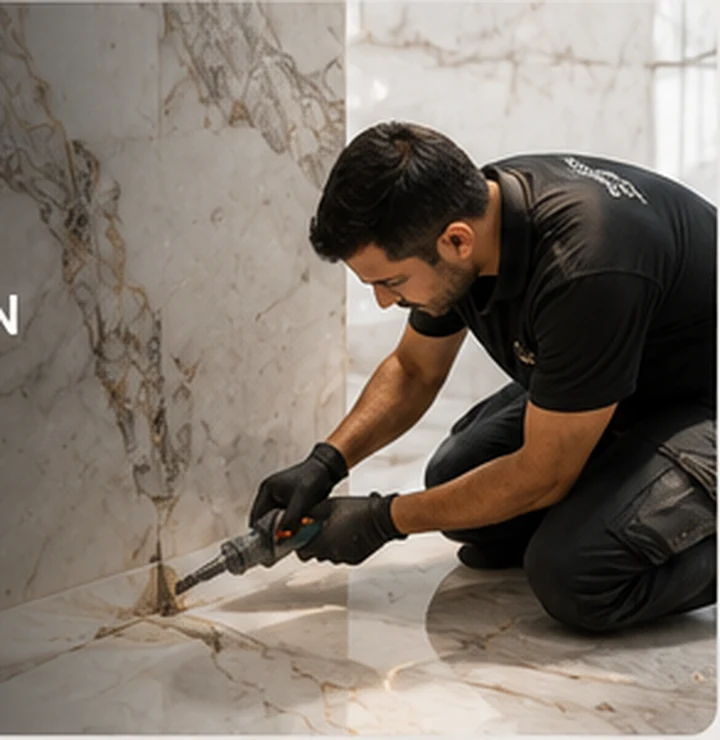
Professional stone repair products based on polyester or epoxy systems are made for filling, bonding and repairing natural stone. The exact resin, tint and repair method should match the location and the type of damage; a cosmetic filler should never be used to hide active movement.
- Clean and prepare the damaged area.
- Use a compatible, colour-adjusted stone filler or adhesive where appropriate.
- Allow it to cure fully, level the repair and refinish it to the surrounding sheen.
- If the crack reopens, stop treating the symptom and investigate movement below.
WHEN TO REPLACE
When replacement is the better long-term choice
Replacement is justified when polishing would only make a failing installation look better for a short time.
Substrate movement is the clearest example. Manufacturers of anti-fracture systems such as Mapei and LATICRETE explain that movement or cracks in the substrate can transfer stress into stone or tile. If a crack keeps returning along the same path, repairing the marble surface alone may not solve the cause.
You should also consider selective or full replacement when a large percentage of tiles are loose, debonded, badly shattered or too thin/damaged to grind safely; when water or substrate damage must be corrected below the marble; or when the planned renovation intentionally changes the material, layout or floor height. If design is the reason for changing the floor, compare the actual stone as a separate decision: warm beige marble, darker armani grey marble, the material commonly marketed under searches such as travertine marble (travertine is geologically limestone rather than marble), and silver travertine all create very different visual results.
- Repeated cracking that follows slab or screed movement.
- Widespread hollow or loose tiles indicating bond failure.
- Large areas of broken stone where repairs would be more visible than replacement.
- Severe lippage or poor original installation that cannot be corrected within safe grinding limits.
- Moisture or substrate defects that require opening the floor.
- A design decision to change the stone, tile size, pattern or floor build-up.
THE RESTORATION PROCESS
What professional marble restoration normally involves
A proper restoration scope is more than applying a glossy chemical. It is a controlled sequence based on the actual depth and type of damage.

Some Dubai contractors also offer crystallisation as a finishing step. Treat it as an optional method within a wider restoration specification rather than as a substitute for correct grinding/honing where physical damage must actually be removed.
- 01
Inspect and identify the stone
Check tile stability, cracks, hollow areas, lippage, stains, etching and previous coatings. A discreet test area helps confirm what finish can realistically be achieved.
- 02
Protect the surrounding property
Mask skirting, joinery and adjacent finishes, and control slurry/water before mechanical work starts.
- 03
Repair stable chips, joints and cracks
Use stone-compatible fillers or adhesives where the defect is suitable for repair. Loose tiles or active cracks need a different solution.
- 04
Grind only when needed
Coarser diamond grinding is used for deeper scratches, lippage and more serious surface damage. A floor that only needs a light finish correction should not be aggressively ground.
- 05
Hone and polish progressively
Successively finer abrasives refine the surface to the chosen honed, satin or polished finish.
- 06
Protect against future staining where appropriate
An impregnating sealer can improve stain resistance on suitable marble, but it does not make marble stain-proof and it does not prevent acid etching.
COST IN DUBAI
How the cost comparison really works in 2026
Do not compare a restoration quote with the raw price of a marble tile. Compare complete scopes.
Published Dubai market guides vary, which is exactly why a site quotation matters. A current 2026 Dubai polishing guide places typical residential marble polishing around AED 15–50 per square metre. A separate 2026 Dubai flooring guide places full restoration of a scratched or etched floor around AED 80–120 per square metre. These are market-planning figures from third-party guides, not our fixed price.
For replacement, the same 2026 flooring guide lists standard-to-mid marble supply and laying around AED 120–370 per square metre before the full finishing package. Its worked all-in examples are about AED 180–280 per square metre for budget marble and AED 320–480 per square metre for mid-range stone; demolition and re-levelling can add roughly AED 40–120 per square metre. Premium Italian stone, bookmatching, large formats and difficult access can take the installed total much higher.
If you are comparing marble with ceramic or porcelain, a separate tile installation cost UAE guide can help you understand why ordinary tile labour should not be treated as the same scope as specialist natural-stone installation.
| Scope | Published planning range | What changes the number |
|---|---|---|
| Maintenance polishing | About AED 15–50/m² | Area, access, existing finish, minimum call-out, stains and edge work. |
| Full restoration of a scratched / etched floor | About AED 80–120/m² | Damage depth, repairs, grinding/honing sequence, final finish and sealing. |
| Standard-to-mid marble supply + laying | About AED 120–370/m² | Stone origin/grade, format, wastage, cutting, layout and labour. Finishing is separate in the source guide. |
| Budget-to-mid replacement, supplied + installed + finished | About AED 180–480/m² | Worked 2026 examples; demolition, disposal and subfloor preparation can be extra. |
| Premium replacement | Can exceed AED 480/m² significantly | Italian stone, slab selection, bookmatching, large slabs, complex fabrication and difficult access. |
Ranges above are synthesized from published Dubai/UAE market guides checked in September 2026. They are not a quotation and can change by project.
TIME & DISRUPTION
Restoration is usually less disruptive than full replacement
Restoration still needs access, protection, machinery, wet slurry control and cure/dry time, but it avoids most demolition and new-material logistics.
A light polish to an accessible area can be completed quickly; grinding, crack repair, edge detailing and a whole-villa scope take longer. Large restoration jobs in Dubai are often measured in days rather than weeks, but the honest duration depends on square metres, furniture movement, room sequencing and how much corrective grinding is required.
Full replacement normally adds removal of the existing marble, debris handling, substrate correction, new material delivery, cutting/setting, adhesive cure, joints and final finishing. It can also affect door transitions such as a marble threshold and adjacent stone details; if the wider renovation includes natural stone window sills, coordinate the finish and stone palette before ordering. In an occupied villa, that difference in disruption can matter as much as the price.
Keep the installed stone
Best when the marble is stable and you are correcting the finish or local damage.
Change only failed pieces
Useful when isolated tiles are broken or loose and a close material match is available.
Rebuild the floor finish
Appropriate when defects are widespread, the substrate must be opened, or the design is changing.
HOW REPAIR WORKS
How can a damaged marble floor actually be repaired?
The repair method depends on whether you are dealing with a surface mark, a missing piece, a crack, a loose tile or damage that originates below the stone.
For etching and scratches
Refine the damaged surface with the appropriate honing/polishing sequence. Deeper scratches need more material removal than simple dullness; the goal is to finish the whole repaired zone uniformly rather than create a shiny patch.
For chips and stable fissures
Clean the defect, remove weak material, fill it with a compatible tinted stone repair system, allow full cure, then level and polish the repair. Tenax publishes professional polyester mastic systems specifically intended for repairing imperfections, filling and bonding marble and other natural stone.
For stains
Identify the stain type before choosing chemistry. The Natural Stone Institute describes poultice methods for oil, organic, metal and other stains; some deep stains cannot be completely removed.
For repeated cracks or loose tiles
Do not keep filling the visible line. Investigate screed/slab movement, adhesion, joints and moisture first. That may lead to re-fixing, crack-isolation work or replacement of affected sections.
IF YOU REPLACE
If replacement is part of a wider renovation, coordinate the adjoining stone work
Replacement decisions affect thresholds, skirting, door clearances, joinery, counters and sometimes raised-access systems. Planning those interfaces together avoids expensive rework.
For a new floor package, our marble installation in dubai page is the internal starting point for installation scope. If your property is in another emirate, you may also be comparing suppliers and contractors; this marble contracting sharjah resource illustrates the broader supply, fabrication and installation scope that can sit around a natural-stone package.
Commercial fit-outs may involve a raised floor system below or beside the final stone finish. That changes finished floor levels, interfaces and access-panel coordination, so it should be resolved before stone sizes and thresholds are finalised.
If the renovation extends into the kitchen, treat kitchen countertops as a separate fabrication scope rather than assuming floor rates apply. This kitchen countertop installation cost dubai guide is useful for understanding why slab selection, cut-outs, edge details and installation are priced differently from floor laying.
Ask what can be reused before disposal. Sound offcuts may be suitable for skirting, small shelves or decorative pieces; a marble tray is one example of how small stone remnants can become a finished object rather than waste.
BEFORE YOU BOOK
What to ask before you authorise repair or replacement
A good quotation should tell you what problem is being solved, not just name a service.
- Which defects are surface-only, and which indicate bond/substrate failure?
- Will you complete a small test area so I can approve the finish first?
- Does the scope include crack/chip repair, grout/joint work, edges and corners?
- If grinding is proposed, why is it necessary and how will you control slurry and protect adjacent finishes?
- If replacement is proposed, what happens to the substrate after removal?
- What stone thickness, batch/lot, finish and layout are included in the replacement price?
- Are removal, waste disposal, cutting, skirting, thresholds, sealing and final polishing included?
- What cleaning products should I use afterwards, and what should I avoid?
RESEARCH & SOURCES
What this guide is based on
We separated technical guidance from local market pricing so you can see where each statement comes from.
Pricing was cross-checked against additional Dubai guides for heavier restoration and marble supply/installation. Because published commercial guides differ, this article deliberately presents ranges and tells you to obtain a written site-specific quotation rather than treating any internet figure as a fixed market tariff.
Natural Stone Institute — Care & Cleaning
Industry guidance on abrasive grit, acid-sensitive calcareous stone, scratches, etching, stains and impregnating sealers.
Open source →MAPEI — Anti-fracture & uncoupling systems
Explains why substrate cracks/movement must be managed beneath ceramic and natural-stone finishes.
Open source →Tenax — Professional Stone Repair Mastic
Manufacturer information for a polishable polyester mastic designed to repair imperfections, fill and glue marble and other natural stone.
Open Tenax source →Dubai market price references
Published 2026 local guides were used only to create broad planning bands; your actual rate depends on condition and project scope.
Open market reference →Natural Stone Institute — Sustainable Natural Stone
Industry guidance on the long service life and durability of natural-stone installations, including flooring.
Open longevity source →Renovel — Marble Flooring Cost Dubai 2026
A current Dubai commercial guide used for broad supply, installation, finishing, demolition and restoration planning ranges.
Open pricing reference →