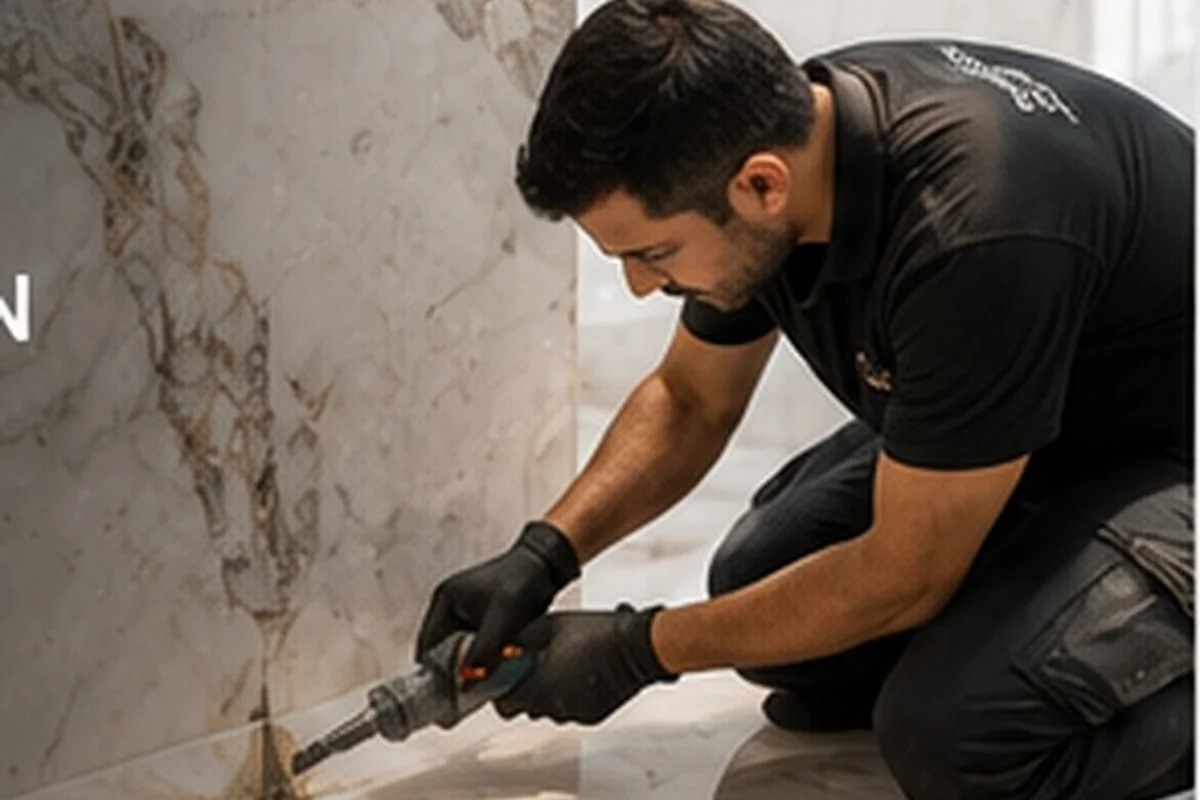
CURRENT POLISHING & RESTORATION PLANNING RATES
Marble Polishing vs Restoration: Current UAE Marble Fixing Rates
The rates are separated because finish refinement, damage correction, crack/chip repair and sealing are different work items.
| Treatment / Repair | Starting Rate | Unit | What It Represents | What Commonly Changes It |
|---|---|---|---|---|
| Marble Polishing & Crystallisation | AED 14 | /m² | Maintenance finish recovery for suitable, generally sound polished marble. | Actual dullness, room layout, edges, previous treatments and whether deeper diamond work is needed. |
| Diamond Polishing | AED 21 | /m² | Progressive mechanical refinement where maintenance polishing alone is not enough. | Starting stage, scratch depth, lippage, stone response, area, edges and final finish. |
| Honing & Refinish | AED 24 | /m² | Low-sheen refinement or an intermediate corrective finishing stage. | Existing finish, stone condition, desired hone, scratches and whether later polishing follows. |
| Full Marble / Stone Restoration | AED 27 | /m² | Broader corrective surface restoration rather than simple gloss recovery. | Damage depth, grinding/honing stages, repairs, joint condition, lippage, access and desired final finish. |
| Scratch Reduction & Blend | AED 33 | /m² | Suitable light-to-moderate scratch correction and blending. | Scratch depth, percentage affected, edge/joint position and whether deeper restoration is required. |
| Premium Restoration Package | AED 48 | /m² | Planning package combining restoration, polishing and sealing where the actual condition suits that scope. | Repair quantity, grinding depth, stone type, finish, access and sealing suitability. |
| Crack Filling | AED 48 | /repair | Small local crack repair where cosmetic treatment is technically appropriate. | Crack width/depth, movement, substrate cause, colour match and whether the crack remains active. |
| Chip Repair | AED 54 | /repair | Localised edge/corner chip repair where a repair system is suitable. | Chip size, missing material, edge profile, colour/vein match and final local polishing. |
| Sealing After Finishing | AED 15 | /m² | Compatible protective sealing after restoration/polishing where appropriate. | Stone porosity, selected sealer, existing treatments, finish and use area. |
These are current UAE Marble Fixing planning rates, not universal Dubai market averages.
DIRECT COMPARISON
Marble Polishing vs Restoration at a Glance
The simplest difference is this: polishing treats the finish; restoration treats damage or deeper condition before the finish is completed.
| Decision Point | Marble Polishing | Marble Restoration |
|---|---|---|
| Main condition | Clean, structurally sound marble with dullness, haze, uneven sheen or light surface wear | Physical damage, deeper wear, chips, cracks, lippage, failed fills, deep scratches or damaged local areas |
| Primary objective | Refine / recover the finish | Correct damage or deeper surface condition before final finishing |
| Typical starting route | Polishing & crystallisation from AED 14/m² | Full marble / stone restoration from AED 27/m² |
| Deeper refinement | Diamond polishing from AED 21/m²; honing & refinish from AED 24/m² | Controlled grinding/honing may form part of restoration where the condition requires it |
| Scratch treatment | Fine/light scratches may reduce during polishing; scratch reduction & blend from AED 33/m² | Moderate/deep scratches may need local repair, deeper grinding, replacement or a restoration programme |
| Cracks and chips | Not repaired by routine polishing | Crack filling from AED 48/repair; chip repair from AED 54/repair as current planning rates |
| Lippage / uneven stone plane | Routine polishing is not the corrective service | Restoration assessment may include controlled grinding/levelling where technically appropriate |
| Etching | Light finish etching may be refinished if the stone is otherwise sound | Deeper/local damage can move into restoration before final polish |
| Final finish | Polished, crystallised or honed finish | Repair/correction first, then final honing/polishing/sealing where appropriate |
A damaged floor can need restoration first and polishing second. The two services can be sequential rather than mutually exclusive.
FINISH WEAR
When Marble Polishing Is the Correct Service
Polishing is appropriate when the stone is broadly sound and the work can focus on refining the surface finish rather than rebuilding damaged areas.
The polishing route starts from AED 14/m² for polishing & crystallisation, AED 21/m² for diamond polishing and AED 24/m² for honing & refinish in the current UAE Marble Fixing planning structure.
If the floor is dirty or filmed, diagnose cleaning first. Polishing should not be used simply because the marble looks tired when contamination may be hiding a sound finish.
- Loss of gloss or clarity
- Hazy / cloudy reflection after the stone is already clean
- Light traffic wear
- Uneven sheen between busy and protected zones
- Fine surface scratches suitable for refinement
- Light etching where local refinishing is technically appropriate
- A polished finish that needs controlled maintenance recovery
Marble Polishing in Dubai
For sound marble with dullness, haze, uneven sheen or suitable light finish wear.
MARBLE POLISHING SERVICE IN DUBAI →Marble Polishing Cost in Dubai
See current AED rates and the factors that change diamond polishing, honing, crystallisation and scratch-reduction quotes.
MARBLE POLISHING COST IN DUBAI GUIDE →DAMAGE & DEEPER WEAR
When Marble Restoration Is the Correct Service
Restoration begins where routine polishing stops being enough: the marble or its local condition needs repair, deeper correction or rebuilding before final finishing.
Full marble / stone restoration currently starts from AED 27/m². Local crack filling starts from AED 48 per repair and chip repair from AED 54 per repair. A premium restoration package combining restoration, polish and compatible sealing starts from AED 48/m² as a planning reference.
Restoration should still be conservative. The goal is not to grind the maximum amount of stone away; it is to correct the condition with the least intervention that achieves the agreed result.
- Deep or moderate scratches
- Chipped edges / corners
- Fine or local cracks where cosmetic repair is technically suitable
- Open or failed fills
- Local lippage / uneven surface plane requiring corrective assessment
- Severely worn areas
- Failed previous repair patches
- Damaged joints
- Local areas needing grinding/honing before re-polishing
Marble Restoration & Repair
For worn, scratched, chipped or cracked marble that needs corrective work before the finish is completed.
MARBLE RESTORATION & REPAIR SERVICE →SCRATCHES
Light, Moderate & Deep Scratches Need Different Routes
Scratch depth is one of the clearest reasons a polishing quote can turn into a restoration scope.
Light surface scratches
May improve through appropriate honing/polishing if they sit within the practical refinishing depth.
Scratch reduction & blend currently starts from AED 33/m² as a planning rate for suitable light-to-moderate scratching.
Moderate scratches
Can require progressive honing or controlled grinding before the final surface is polished.
The affected zone must be blended so a locally corrected patch does not become more visible than the original scratch.
Deep scratches
May remain visible, require substantial local restoration, repair, or in some cases component replacement.
Aggressively grinding an entire floor just to chase one deep defect can be a worse outcome than a targeted restoration strategy.
LOCAL REPAIR
Cracks, Chips & Broken Edges Are Restoration Work
Routine polishing cannot rebuild missing stone or stabilise a crack.
Current planning rates start from AED 48 per small crack repair and AED 54 per local chip repair where the condition is suitable for a cosmetic repair system. The actual repair can change with defect size, depth, edge profile, colour/vein match and how much surrounding refinishing is needed.
A critical limitation is movement. If a crack is being driven by substrate movement, structural movement or another active cause, a cosmetic fill can reopen. The cause must be investigated by the appropriate specialist before the surface repair is treated as permanent.
- Fine crack filling where appropriate
- Local chip repair
- Edge / corner repair
- Small void filling
- Colour-matched repair where practical
- Local polishing / blending after repair
SURFACE PLANE
Lippage & Uneven Marble Cannot Be Solved by Routine Polishing
Polishing changes the finish; it does not automatically correct the geometry between adjacent pieces.
Where adjacent marble pieces sit at different heights, controlled grinding/levelling may be assessed as part of restoration. That process can affect joints, edges, thickness, adjacent finishes and the amount of stone that must later be honed/polished.
Not every height difference should be ground out. The substrate, stone thickness, existing installation and acceptable finished tolerance need review before corrective grinding is approved.
Marble Lippage & Surface Correction
Use the restoration route for uneven stone-plane assessment before any promise of grinding or final polishing.
MARBLE FLOOR RESTORATION ASSESSMENT →ETCHING & STAINS
Etching, Staining & Dull Patches: Which Service Owns the Problem?
A stain changes colour; an etch changes the finish. Both can exist in one area, but the sequence matters.
Selected stains should be identified and treated as contamination first. Once the stain is removed or reduced, any remaining etched/dull finish can be assessed for local honing/polishing or restoration.
A deep or old mark can be more complex than routine polishing. The source, duration, stone, previous chemicals and depth determine the treatment and the achievable result.
Marble Cleaning vs Polishing
Use this guide to separate dirt, residue and staining from finish wear before a restoration scope is approved.
MARBLE CLEANING VS POLISHING GUIDE →JOINT CONDITION
Failed Joints & Fills Can Make a Polished Floor Still Look Damaged
The stone surface and the joint system are visually read together.
Open, dirty, cracked or deteriorated joints can remain visible even after the marble has been beautifully polished. Where joint renewal is appropriate, the repair sequence should identify removal of unsuitable material, cleaning, depth/condition check, application of the approved joint material, curing and final inspection.
Joint colour, width, depth and flexibility should suit the stone and installation condition. A rigid cosmetic fill should not be used to hide an active movement joint.
RESTORE THEN FINISH
Why Restoration Usually Ends With Honing or Polishing
Repairing a chip or grinding a damaged area changes the local surface. The final finishing stage is what visually reconnects the restored zone with the surrounding marble.
Stone Surface Finishing
Use the finishing route when the restored stone needs a specific polished, honed or protected final surface.
STONE SURFACE FINISHING SERVICE →- 01
Condition assessment
Map scratches, cracks, chips, lippage, joints, stains and previous repairs.
- 02
Cleaning / preparation
Remove contamination so the actual defects and finish can be seen.
- 03
Local repair
Treat approved chips, cracks, edge damage, voids or joints using the selected repair system.
- 04
Grinding / honing where required
Use progressive correction only where the damage or surface plane requires it.
- 05
Re-polish or finish
Blend the corrected area to the agreed polished or honed finish.
- 06
Seal where appropriate
Apply a compatible sealer only where the stone and use area benefit from it.
- 07
Final inspection
Review repaired areas, joints, finish consistency and the agreed scope before handover.
COMMERCIAL DIFFERENCE
Polishing Cost vs Restoration Cost
Restoration starts higher because the work can include repair and deeper correction before final finishing.
Current UAE Marble Fixing planning rates start from AED 14/m² for polishing & crystallisation and AED 27/m² for full restoration. The premium restoration package starts from AED 48/m² where restoration, polish and sealing are all suitable to the project.
Do not assume the restoration rate includes every crack, chip, stain or structural issue. Local repairs, specialist stain work, substrate correction, moisture investigation or component replacement can be separate.
| Condition | Likely Route | Current Starting Reference | Commercial Note |
|---|---|---|---|
| Clean but dull / hazy | Polishing & crystallisation | AED 14/m² | Finish recovery |
| Needs diamond refinement | Diamond polishing | AED 21/m² | Deeper finish correction |
| Needs honed / low-sheen refinish | Honing & refinish | AED 24/m² | Finish refinement |
| Broader damage / worn surface | Full restoration | AED 27/m² | Corrective restoration before final finish |
| Light-to-moderate scratching | Scratch reduction & blend | AED 33/m² | Suitability depends on scratch depth |
| Restoration + polish + sealing scope | Premium restoration package | AED 48/m² | Only where the combined scope is appropriate |
| Local crack | Crack filling | AED 48/repair | Active movement can require specialist investigation |
| Local chip | Chip repair | AED 54/repair | Size/profile/colour match affect final quote |
Planning references only; the written quotation controls the actual scope.
LIVE-SITE RESTORATION
Villas, Hotels & Commercial Spaces Need More Than a Machine Plan
Corrective restoration can be more disruptive than routine polishing because repairs, grinding, curing and phased finishing can be involved.
Occupied homes may require furniture movement, protection, room-by-room sequencing and safe daily access. Hotels and commercial spaces can add night work, phased handover and restrictions around guests, tenants or trading hours.
The quotation should therefore state access, protection, working hours, curing/return-to-use assumptions and whether repair materials need additional time before final finishing.
COMPARE THE SAME CONDITION
How to Compare Polishing & Restoration Quotations
A cheap polishing quote and a restoration quote are not alternatives if they are pricing different conditions.
- Does each company agree on the actual defect?
- Is the floor only dull, or physically damaged?
- Are scratches classified by depth?
- Are crack/chip repairs included or excluded?
- Is lippage correction included or excluded?
- Are grinding/honing stages identified?
- Does the quote include final polishing after repair?
- Are joint repairs included?
- Is sealing included or optional?
- Are furniture, protection and access included?
- Are structural/substrate movement issues excluded from cosmetic repair?
- Is the intended final finish stated?
FROM PHOTO TO RESTORATION PLAN
How to Get the Polishing vs Restoration Decision Right
The fastest route to an accurate scope is to show both the whole floor and the actual defects.
- Project location and property type
- Approximate marble area
- Wide photos under side / natural lighting
- Close-up photos of scratches, cracks, chips and joints
- Photos showing lippage or unevenness from low angle
- Marble/stone type and finish if known
- Any previous polishing, coatings, repairs or fillers
- Whether cracks have reopened before
- Whether moisture or movement is suspected
- Stairs / edge-heavy zones
- Furniture and access conditions
- Required final finish
Marble Polishing or Restoration Assessment
Send the surface photos and defect details before you approve a finish-only or corrective scope.
REQUEST MARBLE POLISHING OR RESTORATION ASSESSMENT →- 01
Map the condition
Separate dullness, scratches, chips, cracks, lippage, joints and stains.
- 02
Identify what sits only in the finish
Light dullness and fine wear can stay within polishing.
- 03
Identify what needs corrective work
Deep defects and physical damage move toward restoration.
- 04
Inspect movement / substrate questions
Do not treat an active crack as purely cosmetic.
- 05
Write the sequence into the quotation
State repair, grinding/honing, polishing, sealing and exclusions separately.
BUDGET EXAMPLES
How the Polishing & Restoration Starting Rates Compare
These are simple arithmetic illustrations using current UAE Marble Fixing planning rates. They are not final quotations.
100 m² polishing & crystallisation
100 × AED 14/m² AED 1,400 starting calculationAppropriate only when the marble is suitable for maintenance-focused finish recovery.
100 m² full marble restoration
100 × AED 27/m² AED 2,700 starting calculationThe actual restoration can increase with grinding depth, lippage, repairs, joints, access and final finish.
50 m² scratch reduction & blend
50 × AED 33/m² AED 1,650 starting calculationOnly for suitable light-to-moderate scratching; deep defects may need a different restoration strategy.
60 m² premium restoration package
60 × AED 48/m² AED 2,880 starting calculationRepresents the current planning package where restoration, polishing and compatible sealing are all appropriate.
3 local crack repairs
3 × AED 48/repair AED 144 starting repair calculationActive structural/substrate movement can make a cosmetic repair unsuitable or temporary.
4 local chip repairs
4 × AED 54/repair AED 216 starting repair calculationChip size, edge profile, missing material, colour match and local polishing affect the final scope.
Each example is a separate treatment illustration. Do not add them together unless the written project scope actually contains those items.
BEFORE YOU CHOOSE THE SERVICE
Eight Questions That Decide Polishing vs Restoration
Use the defect—not the service name—to make the first routing decision.
Is the marble only dull?
If yes and the stone is otherwise sound, polishing is usually the first route.
Are scratches fine or deep?
Fine scratches can stay in refinement; deeper scratches can require restoration.
Are there cracks or chips?
Physical repair belongs to restoration, not routine polishing.
Is the floor uneven at the joints?
Lippage/plane correction requires restoration assessment rather than a finish-only quote.
Are joints or previous fills failing?
Repair them before expecting final polishing to look complete.
Is the mark a stain or an etch?
Treat contamination first; refinish the surface only if etching/damage remains.
Is there active movement or moisture?
Cosmetic restoration should not hide an unresolved substrate/structural cause.
What final finish is required?
Restoration still needs a defined polished, honed or other compatible final surface.
RENOVATION CONTEXT
Existing-Property Work Makes Condition Assessment More Important
These project records are shown only as renovation/property context. They do not claim that polishing or restoration formed part of the historic scope unless verified in the individual case study.
RenovationDubai
DXB Tower Renovation
Renovation environments can include prior finishes, repairs, occupied access and unknown substrate history that affect restoration planning.
DXB TOWER RENOVATION PROJECT CASE STUDY → HotelDubaiMövenpick Grand Garhoud Renovation
Hospitality renovation context illustrates phased work, protection and live-site handover requirements.
MÖVENPICK GRAND GARHOUD RENOVATION PROJECT → TowerDubaiIndex Tower 3208
Apartment/tower context is relevant to access, furniture, lift logistics and localised surface condition.
INDEX TOWER 3208 PROJECT CASE STUDY →Natural Stone Institute care guidance separates routine care/finish issues from conditions that need professional refinishing. It notes that etch marks can require refinishing/repolishing and that deeper scratches and nicks should be repaired and repolished by a professional. That supports the core rule in this guide: polishing is a finish treatment; restoration is the corrective route when physical damage or deeper surface condition must be addressed first.
- Etching changes the finish and can require professional refinishing/repolishing.
- Deeper scratches and nicks move beyond simple routine maintenance.
- Cracks related to active movement should not be treated as only cosmetic.
- UAE Marble Fixing company rates are used for all budget examples; external sources are not averaged into new company rates.